
Categories
Media trainings

Why Message Maps Help Spokespeople Perform Better in Media Interviews

Message maps help spokespeople approach media interviews with clarity and confidence by defining in advance what they want to communicate and why.

Media interviews are a powerful way for company leaders to position their organizations. They offer visibility, credibility, and the opportunity to speak directly to clients, prospects, investors, and other stakeholders through trusted third parties. When they go well, media interviews can meaningfully strengthen a company’s reputation.

At the same time, media interviews can be challenging. They put spokespeople under pressure. Questions come quickly, answers are public, and there is little room to correct missteps once something has been said. In that environment, even experienced leaders can find themselves reacting to questions rather than communicating deliberately.

Why Preparation Matters More Than the Right Questions

For that reason, spokespeople do well to carefully prepare the messages they want to convey in media interviews in advance. If they fail to do so, the success of their media performance becomes dependent on the journalist asking the “right” questions. This is a risky strategy, not because journalists are careless, but because their role is not to help the spokesperson structure their message. Their role is to serve their audience.

From the spokesperson’s perspective, this creates an additional challenge. Media interviews impose cognitive pressure. People must listen carefully, formulate answers quickly, and manage how they come across, all at the same time. Under these conditions, spokespeople tend to respond reactively. They focus on answering the question in front of them rather than on advancing the messages they want their audiences to take away. This is where message maps come in.

What a Message Map Does

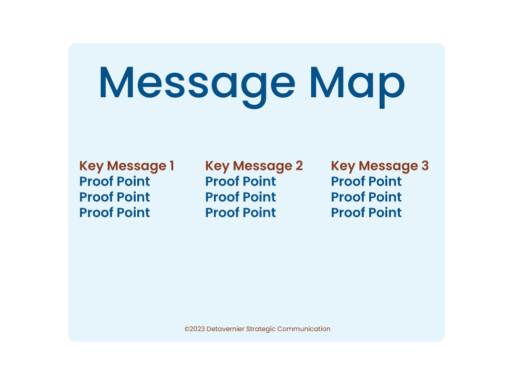
Through a message map, all key messages a spokesperson plans to convey in a media interview are laid out in advance. These messages are selected in function of the communication objectives the spokesperson wants to achieve. Those objectives will always relate to changing how at least one group of stakeholders knows, feels, or acts in relation to the topic at hand.

Consider a company that wants clients, prospects, and potential investors to understand that it is growing rapidly and that further growth lies ahead. Media messages at the start of the year could include one key message about strong organic growth in the previous year, and a second key message about strategic investments made to sustain growth in the coming year. The message map ensures that these points are top of mind before the interview begins, rather than being recalled opportunistically during it.
 

The Limits of Attention: Fewer Messages, Greater Clarity

Because people can only retain a limited number of ideas at once, message maps typically contain no more than three to five key messages. This limit is not arbitrary. When messages are clearly structured and rehearsed in advance, they are easier to retrieve under pressure. In that sense, a message map functions less as a script and more as a mental guide that reduces the effort required during the interview itself.

Credibility Requires Proof Points

For key messages to be perceived as credible, they also need to be supported by facts and figures. Specifics matter. Audiences tend to trust concrete statements more than general ones, even before verifying them. Numbers, timelines, and clearly defined actions signal seriousness and preparation.

Returning to the growth example, an organization that claims it has made strategic investments must be prepared to share at least a minimum level of detail. This could include the type of investments made, the scale of those investments, or the areas they are intended to strengthen. Without such specifics, key messages risk sounding vague or gratuitous.

Staying Anchored Under Pressure

Message maps also help spokespeople avoid a common pitfall in interviews. When faced with a difficult or unexpected question, people often answer a simpler version of that question rather than the one that best serves their objectives. A message map counteracts this tendency by keeping the spokesperson anchored to what matters most, even when the question itself offers limited opportunity to do so.

From Improvisation to Direction

In conclusion, spokespeople who are equipped with a thoughtfully constructed message map enter media interviews with a clear sense of direction. They are less dependent on the journalist’s line of questioning and better able to place their key messages and proof points where they belong. As a result, they tend to deliver clearer, calmer, and more effective media performances than interviewees who rely on improvisation alone.

Interested in learning more about evidence-based tips for effective media interviews? On 2 April, Jo Detavernier will host a webinar featuring 100 practical tips for successful media interviews. More information on the content and registration can be found here.


Categories
Crisis communications

Jo Detavernier speaks at PRSA Houston PR Day

Jo Detavernier will speak about evidence-based crisis communication at PRSA Houston’s PR Day.

The annual edition of PRSA Houston’s PR Day will take place on 22 November this year. At this event, public relations and communications professionals of all levels and from all industries gather together during one day to learn from one another.

PR Day 2023 will be held at Hotel Zaza in Houston’s Museum district. Anyone who is interested in attending (PRSA membership is not required) can register on this page.

Focus areas of the 2023 PR day include communications strategies and tactics, digital content trends and best practices, reputation management, and crisis communication. Jo Detavernier will talk about the latter topic – in his lecture he will elaborate on what evidence-based crisis communication looks like and how practitioners can apply an evidence-based approach in all of the work they do helping organizations prepare for and communicate in crises.

Anyone who is interested in evidence-based crisis communication will find more information on the topic in Jo Detavernier’s contribution to the recently published second edition of the Handbook on Crisis Communication.

Categories
Company news

Jo Detavernier will be a guest lecturer at Let’s Talk Science

Jo Detavernier will be a speaker at this year’s Lets Talk Science summer school.

Let’s Talk Science is an annual event at which Flemish universities and non-university institutes of higher education help their researchers hone their communicate skills. This year, event takes place from 4 to 6 July and is hosted by the Ghent University.

Jo Detavernier’s lecture will be titled “A media relations survival kit for researchers” – Jo will give the lecture on 6 Juli at 02:00 PM CET.

In the workshop, students will gain insights into:

  • how media organizations produce content;
  • what journalists care for in a story (what constitutes “news?”);
  • how one can best prepare for interviews;
  • what delivery techniques matter the most;
  • how researchers can communicate clearly to a non-academic audience;
  • what to pay attention to when giving tv, radio, print interviews;
  • the written and unwritten laws on attribution and exclusivity;
  • how researchers can work efficiently with professional communicators in their organization;
  • how to correct course when interviews go wrong.

Categories
Crisis communications

Evidence-Based Crisis Communication in a New Handbook

Jo Detavernier contributed a chapter on evidence-based crisis communication to a new handbook edited by Timothy W. Coombs and Sherry J. Holladay.

The Handbook of Crisis Communication offers students, researchers, and practitioners a timely and comprehensive overview of the crisis communication field. Contributions from more than 50 scholars and practitioners reflect a wide range of methodological approaches, examine how crisis communication is applied across diverse contexts, explore the role of culture and technology, and present original research relevant to the development and evaluation of crisis communication theory.

The second edition of the Handbook comprises 38 chapters and delivers fresh insight into established areas of crisis communication while also addressing new and emerging lines of research. It integrates a broad range of new case studies, practical scenarios, and in-depth analyses of recent crises, making the volume particularly valuable for both academic study and professional practice.

Jo Detavernier contributed a chapter on how crisis communication can be developed as an evidence-based practice. In his chapter, he outlines scientifically validated insights drawn from crisis and risk communication research and shows how practitioners can integrate an evidence-based approach into their everyday crisis communication work.

The Handbook of Crisis Communication is published by John Wiley & Sons. More information about the book, including the table of contents, is available on the the publisher’s website. A shortened version of Jo Detavernier’s chapter is presented in this blog post.

Categories
Company news

Detavernier Strategic Communication will provide PR support to Belgian trade mission

From June 4 to 11, HRH Princess Astrid of Belgium will lead an economic mission to Atlanta, New York City and Boston. Detavernier Strategic Communication will manage media relations for the mission in all three cities.

With over 540 participants from 270 leading Belgian companies, this will be one of the largest Belgian trade missions ever organized.  The aim of the mission is to explore further opportunities to strengthen partnerships between Belgium and the United States and to highlight the shared focus of the two countries on technology. The companies that will be visited by the trade delegation to the United States will be a mix of subsidiaries of Belgian companies and local companies that have strong ties to Belgium (in the former group of companies one will find AB Inbev (New York City), Solvay (Alpharetta, GA) and UCB (Smyrna, GA).

Detavernier Strategic Communication will provide strategic counsel and on-site support for the mission’s local media outreach. The agency wil inform local journalists on the program of the mission in their respective cities, pitch select events and set up and staff interviews.

Categories
Company news

Jo Detavernier participates in Crisis Comms Mastery event

Jo Detavernier will talk about how crisis communications can become evidence-based at the upcoming Crisis Comms Mastery virtual summit.

From March 24 until March 26, crisis communications experts will once more share their insights on how to prepare for, respond to and resolve a crisis like a PR master. From having the right tools, to getting a rock-solid crisis plan in place, to managing the story, attendees will learn how to make their brand or client ready to weather any storm.

The Crisis Comms Mastery virtual summit is organized by Agility PR Solutions. Attendance is completely free. Among the speakers at the previous edition of the Crisis Comms Mastery virtual summit are Melissa Agnes, Deborah Hileman, and Brad Phillips

Jo Detavernier’s session will revolve around how crisis communications specialists can make their profession a truly evidence-based one through the application of insights from the behavioral sciences, but also by embedding and nurturing a culture of evidence-based practice in their organization.

Anyone who is interested in registering, can do so here.

Categories
Company news

Detavernier Strategic Communication among 19 best Austin PR firms

Expertise.com ranked Detavernier Strategic Communication among the top 19 Austin PR firms.

Expertise’s research and selection process identifies the top service professionals in over 200 different industries across the major cities in the United States. Every month, Expertise helps over 1 million customers find the best qualified service professionals.

52 PR agencies in Austin have a profile page on Expertise and of those 52, 19 have been selected by Expertise as the very best PR agencies on the Austin market. Among the criteria that Expertise uses to grade agencies are:

  • Reputation: A history of satisfied customers giving excellent recommendations
  • Qualifications: Established in their industry with licensing, accreditations, and awards
  • Experience: Masters of their craft, based on years of practical experience and education
  • Engagement: Approachable and responsive to clients and available for new business
  • Professionalism: Dedicated to providing consistently quality work and impeccable customer service

Detavernier Strategic Communication received an A for Reputation and an A+ for Professionalism (the firm did not receive scores on the other criteria).

A crowded market in an unregulated industry comes with a great many challenges for PR service providers to stand out (I talked about this challenge in this article about PR accreditations) – my team and I will continue to invest and work hard towards providing our domestic and foreign clients with high-quality strategic counsel and support.

Categories
Media relations

Webinar: Introduction to American tech media relations

On March 25th, Detavernier will host a webinar on American tech media relations with as a special guest Omar Gallaga (WSJ, CNN, Washington Post, NPR).

The webinar will focus on how European tech companies can be successful building their brands and activating demand through media relations on the American market. It is suited for entrepreneurs, marketing managers and PR managers. Topics that will be covered are:

  • The American tech media landscape
  • The American tech media relations toolbox
  • Crafting and pitching stories to American tech media
  • B2B thought leadership in American tech media
  • B2C product pr in American tech media
  • Media relations in times of COVID-19
  • Preparing and giving media interviews
  • Picking the PR tech stack
  • Sourcing consultancy services on the American market

SPECIAL GUEST Omar Gallaga (WSJ, CNN, NPR, Washington Post) will share his thoughts and experiences receiving media pitches on “the other side” and will be available to answer questions during a 15 min AMA session.

No public recording will be made available afterwards to anyone who has not registered.

To register, visit this page.

Categories
Media trainings

Detavernier Strategic Communication hosts open media training at FINTECH Belgium

FINTECH Belgium welcomes Jo Detavernier for a remote, open media training on March 2.

The content of this evidence-based media training was developed through an exclusive collaboration with Communication Science Group.

The training will last 75 minutes and will include:

  • an overview of what the media wants: news value, “desk opinion,” and media coverage as a product
  • an overview of the Belgian media market, with a special focus on fintech
  • a brief aside on preparing for media relations abroad
  • preparation for media interviews, including message maps, Q&As, and handling “tough questions”
  • evidence-based techniques for designing and delivering messages during media interviews, with particular attention to headlining, flagging, and bridging
  • one tailored mock interview with a spokesperson
  • the unwritten “rules” around attribution, scoops, and exclusives
  • best practices for following up after media interviews

Interested participants can register on this page.

Categories
Media trainings

Detavernier Strategic Communication will host a virtual media training on June 4

A new, unique online session will teach participants evidence-based media interview preparation and delivery techniques.

In this one-hour online training session, Jo Detavernier will clearly explain – and illustrate with examples and demonstrations:

  • how spokespeople should prepare for media interviews (15%)
  • what effective media interview delivery techniques look like (80%)
  • how interviewees should follow up with journalists (5%)

Among the delivery techniques covered are bridging, flagging, and headlining. Participants will also learn how to best prepare and structure their messaging, how the media works (including news value, attribution, and exclusivity), and what to do once the interview has taken place.

Special attention will be given to message development and delivery techniques that are evidence-based, meaning that psychological research has validated these techniques as effective.

After the session, participants will receive a video recording of the training, which will not be made public or shared with others.

Ten percent of the proceeds will be donated to Bookspring,, an Austin, TX–based nonprofit that makes gently used children’s books freely available to low-income children in Central Texas.