
Categories
Media relations

Setting Accountable Objectives in B2B PR

B2B PR objectives setting requires translating strategic goals into SMART, outcome-level objectives that the PR function fully owns and evaluates through an AMEC-aligned framework distinguishing inputs, outputs, outcomes, and impact.

One of the recurring challenges in B2B public relations is not a lack of activity, but a lack of accountability. Organizations invest time and resources in PR, yet struggle to define objectives that allow them to assess whether communication efforts achieved what they were intended to achieve.

That challenge persists despite the fact that most PR teams do measure their work. According to Muck Rack’s 2025 State of PR Measurement report, 81% of PR professionals say they measure their PR efforts, yet 61% do not follow any formal measurement framework, and only a very small minority, around 4%, report using the AMEC Integrated Evaluation Framework.

Measurement is widespread, but structured, framework-based evaluation remains the exception rather than the rule. This matters now because PR teams face increasing budget scrutiny, rising expectations to demonstrate value, and growing measurement noise driven by AI, making clear, outcome-level accountability more important than ever.

Among the various approaches to PR measurement, the AMEC Integrated Evaluation Framework is the most developed and methodologically rigorous framework available, even if it is not widely adopted in day-to-day practice. A disciplined approach to objective-setting informed by this framework helps close the gap between activity and accountability. This article outlines how to set B2B PR objectives in a way that is measurable, defensible, and aligned with AMEC principles, while remaining practical for day-to-day PR practice.

Start With Strategic Goals

Objective-setting in B2B PR begins with goals, not metrics.

Goals are high-level and directional. They describe what the organization wants to achieve at a business or strategic level, without yet specifying how communication performance will be assessed. In B2B PR, such goals typically include increasing visibility, strengthening credibility, improving competitive positioning, stabilizing or improving reputation, or supporting broader commercial ambitions.

Goals provide strategic direction, but they are not yet suitable as performance criteria for PR.

Translate Goals Into SMART Objectives

Goals become operational when they are translated into SMART objectives that sit squarely within the PR team’s remit.

In B2B PR, SMART objectives should be Specific and unambiguous (S), Measurable (M) through defined indicators, Accountable to the PR function (A), Realistic (R) given baseline conditions, and Time-bound (T). Together, these criteria ensure that objectives are clear, assessable, and fully controllable by the PR function. This does not mean PR controls the broader environment in which communication takes place, but it does mean that PR is wholly accountable for whether the objective has been achieved or not.

For example, a general goal such as increasing awareness can be translated into a SMART PR objective such as increasing Excess Share of Voice (ESOV) versus two primary competitors by four percentage points within twelve months (Excess Share of Voice being the difference between a company’s share of media visibility and its share of market). This objective is fully within PR’s control, because PR owns the strategy, execution, and evaluation required to achieve it, even though market dynamics influence how difficult it may be.

Other common B2B PR goals translate into SMART objectives in similar ways. A thought leadership goal may become an objective such as increasing the proportion of coverage that positions the company or its executives as expert sources on a defined topic within nine months in priority business and trade outlets. A competitive positioning goal may translate into achieving a higher share of voice than named competitors on a specific narrative within a defined media universe of priority business and trade outlets. A reputation-related goal may be expressed as reducing the proportion of neutral-to-negative coverage in priority business and trade outlets by a defined percentage over a twelve-month period. A credibility goal may focus on increasing the share of coverage in top-tier business and trade media relative to lower-tier mentions.

In each case, the objective defines a communication result that PR owns end to end, rather than an activity to be completed or a business result to be claimed.

Inputs, Outputs, Outcomes, and Impact

Once objectives have been defined, companies distinguish between inputs, outputs, outcomes, and impact when planning and evaluating PR performance. In line with the AMEC framework, this means that both outputs and outcomes are explicitly defined, but only outcomes are treated as SMART objectives; outputs are planned and tracked as leading indicators that support those objectives.

Inputs describe the resources invested in PR, such as budget, time, staffing, agency support, and campaign scope. Inputs explain what is available to the PR team, but they are not measures of success.

Outputs are the immediate, observable results of PR activity and function as leading indicators. In practice, this includes the volume and quality of media coverage, presence in priority business and trade outlets, message pull-through, and spokesperson inclusion. Outputs are typically tracked on a regular basis and are primarily used to steer execution.

Outcomes are where PR accountability sits. Outcomes describe the communication effects that PR is responsible for delivering, such as relative visibility, awareness lift, expert positioning, narrative dominance, or changes in coverage tone or framing. Measures such as ESOV, shifts in expert attribution, or improvements in coverage balance within priority business and trade outlets are outcome-level indicators. Because outcomes reflect accumulated communication effects, they function as trailing indicators and are typically assessed over longer time horizons.

Impact, by contrast, is where PR relevance is demonstrated rather than owned. Impact refers to broader organizational effects such as pipeline development, employer attractiveness, long-term reputation strength, or category leadership. AMEC expects practitioners to identify relevant impact indicators and to explain how PR outcomes plausibly support them, while avoiding claims of direct causality. Impact provides business context and strategic relevance, but it is not the level at which PR SMART objectives should be set.

This distinction is fundamental. PR is fully accountable for outcomes, while impact explains why those outcomes matter in a wider organizational context.

Feedback Loops and Continuous Improvement

Measurement in B2B PR should be embedded in a recursive planning and evaluation process, meaning that evaluation at any point can be used to adjust what is done at any earlier stage.

If an outcome-level objective is not reached, this does not automatically mean execution was poor. It may indicate that assumptions were incorrect, that resource allocation needs adjustment, or that a different approach is required to achieve the desired outcome.

Linking Outputs, Outcomes, and Impact

An AMEC-aligned approach does not treat outputs as success in themselves. Outputs indicate whether execution is on track. Outcomes determine whether PR objectives have been achieved. Impact explains why those outcomes matter to the organization.

Keeping these levels distinct strengthens accountability rather than weakening it.

Why This Matters in B2B PR

B2B PR operates in complex buying environments, long sales cycles, and competitive media markets. Clear distinctions between inputs, outputs, outcomes, and impact, and a clear understanding that PR objectives must be fully owned at the outcome level, are therefore essential.

When objectives are derived from strategic goals, formulated as outcome-level SMART objectives, and evaluated using appropriate leading and trailing indicators, PR performance can be assessed fairly, discussed credibly with leadership, and improved systematically over time.

That logic sits at the core of the AMEC Integrated Evaluation Framework, and it provides a practical foundation for accountable, effective B2B PR.


Categories
Media relations

How B2B Companies Can Amplify Media Coverage Long After It Appears

B2B companies can amplify media coverage by systematically extending earned visibility across websites, social media, newsletters, sales conversations, and branded search moments.

For B2B companies, earned media coverage remains one of the most credible ways to build visibility, trust, and brand authority with external audiences such as buyers, prospects, partners, investors, and other stakeholders who shape commercial outcomes. A well-placed article or interview in a respected trade or business outlet signals relevance and legitimacy in a way few owned or paid channels can replicate.

Yet too many organizations treat media coverage as a one-off event. The article is published, the interview airs, a link is shared once on social media, and attention quickly shifts to the next pitch. In doing so, companies leave meaningful value on the table.

In reality, earned media should be viewed as a durable asset rather than a fleeting moment. With a thoughtful amplification strategy aimed at external audiences, a single piece of coverage can support brand building, demand generation, sales conversations, and commercial validation for months or even years after publication.

Turn media coverage into owned content without copying it

One of the most straightforward and underused amplification tactics is to reference media coverage on your own website. This can take the form of a short blog post or a newsroom item that highlights the article and links to the original publication.

The emphasis should be on context rather than reproduction. Companies should avoid copying the article or lifting extended excerpts. Instead, they can briefly describe what the piece covered, why the topic matters to the market, and what readers can expect if they click through. This allows organizations to frame the coverage for their audience while respecting the publisher’s work.

As a professional courtesy and to manage expectations, companies should also clearly indicate when the article they are linking to is gated or behind a paywall. Transparency reflects well on the brand and avoids frustrating readers.

Share the coverage on social media strategically and repeatedly

Social media amplification should extend well beyond a single post on the day an article appears. For B2B organizations, LinkedIn is by far the most important platform given its concentration of decision-makers and industry professionals.

The spokesperson who gave the interview should share the coverage and ideally add context on why the topic matters or what prompted the discussion. Amplification should not stop there. Employees, particularly those in leadership, sales, and subject-matter roles, can be encouraged to share the article with their own networks to extend reach organically.

In parallel, the company’s LinkedIn page should publish its own post written in a more institutional voice. That post can be reshared over time as the topic remains relevant or resurfaces in industry conversations. For especially strong or strategic coverage, selective paid promotion can further extend reach by placing credible third-party validation in front of clearly defined target audiences.

Extend the impact through newsletters

Email newsletters remain a powerful owned channel in B2B, particularly when audiences have opted in for insight rather than promotion. Earned media fits naturally into this environment.

Companies can include a short description of the article in their newsletter, either as native editorial content or as a link to the blog or newsroom post that references the coverage. Over time, consistently featuring earned media reinforces the perception that the organization’s perspectives are sought out by respected third parties.

Use earned media to support sales conversations

Beyond marketing channels, earned media can play a meaningful role in sales enablement. Links to relevant articles can be shared in one-to-one prospect emails, referenced in sales decks, or cited in RFP responses and procurement documentation.

In long B2B buying cycles, buyers often seek reassurance that a company is credible, established, and recognized beyond its own messaging. Earned media provides that validation at precisely the stage where trust and risk reduction matter most.

Use email signatures as quiet amplifiers

A subtle but effective tactic is to reference media coverage in email signatures. A single line such as “As featured in” followed by the publication name and a link to the article reinforces credibility in every external interaction.

Because email signatures appear in personal correspondence, this form of amplification feels understated rather than promotional. It works particularly well in sales, business development, and partnership contexts. Accuracy is essential. Companies should always link to the actual article and avoid language that could imply endorsement.

Reinforce credibility in branded search moments

Earned media also plays an important role when external audiences actively research a company. Prospective buyers rarely rely on a single source. Instead, they look for consistency between what a company says about itself and what independent third parties say about it.

By referencing media coverage on their own site and linking to original articles, companies strengthen branded search results without ceding narrative control. The goal is not for third-party articles to outrank owned pages, but for earned media to appear alongside them as independent validation when buyers are assessing credibility and reducing perceived risk.

Showcase media logos carefully and correctly

Many B2B websites include logos of media outlets in which the company has appeared. When done correctly, this can be a powerful trust signal. Tier-one and respected trade publications carry real brand equity, and prospective buyers notice.

Precision matters. Using phrasing such as “As featured in” is widely accepted and legally safe in the United States provided coverage is accurately represented and not overstated. Companies should avoid implying endorsement or partnership where none exists and remain selective in which logos they display.

Leverage print and broadcast within licensing rules

For organizations that rely heavily on in-person sales, conferences, or investor meetings, sharing media coverage in physical or audiovisual form can still be effective. A printed article or referenced broadcast segment can lend weight to conversations.

Legal considerations are critical. Reproducing print articles typically requires a license from the publisher. Without permission, companies are not allowed to copy or distribute articles, even if the coverage is about them.

The same principle applies to broadcast media. While it is acceptable to link to a television or radio segment on the outlet’s own platform, downloading an episode and hosting it on company-owned channels without permission is generally not allowed. Linking rather than hosting is the safest and most professional approach.

From moment to asset

When treated strategically, media coverage is not an endpoint but a starting point. Thoughtful amplification aimed at external audiences transforms earned media into a compounding asset that reinforces credibility across marketing, sales, and brand touchpoints long after the initial publication or airing.

For B2B companies operating in trust-driven, high-consideration markets, this shift in mindset can make the difference between fleeting attention and durable brand equity.

Categories
Crisis communications

How to Put Evidence-Based Crisis Communication into Practice

An overview of how communication professionals can apply insights from academic research to design, implement, and institutionalize evidence-based crisis communication in real-world organizational settings.

This article is a substantively shortened version of a chapter written by Jo Detavernier for the second edition of The Handbook of Crisis Communication (Coombs, W. Timothy & Holladay, Sherry J., eds.). The book can be ordered on Amazon through this link.

Both in-house crisis communication professionals and the consultants who advise them stand to benefit substantially from applying insights from academic research to crisis preparation and response. A commitment to evidence-based crisis communication strengthens not only the effectiveness of communication outcomes, but also the professional credibility of those responsible for shaping them.

Business communication as a management practice remains a relatively young discipline. As a result, much remains unknown about what makes communication, particularly crisis communication, consistently effective and efficient. Although notable efforts have been made to codify professional knowledge and develop a shared body of standards, the field still lacks the degree of theoretical consensus found in more mature professions.

A comparison with medicine helps clarify this point. When visiting different physicians for the flu, patients may receive slightly different recommendations, but there is universal agreement among accredited doctors about the biological mechanisms at work when a virus enters the body. In contrast, when organizations consult multiple communication professionals about a reputational issue, they may encounter disagreement not only about how to respond, but even about whether a reputational problem exists at all. Empirically validated approaches to crisis communication are rarely applied with the same degree of consistency.

Despite these limitations, the field of communication is far from devoid of reliable knowledge. A growing body of scientific research provides valuable guidance on how communication functions in high-stakes contexts. When professionals adopt an evidence-based approach, they are more likely to achieve their communication objectives, contribute meaningfully to organizational goals, and articulate defensible rationales for their decisions to internal stakeholders. Over time, this strengthens both their credibility and their influence within organizations.

Evidence-Based Management

Rob Briner defines evidence-based management as the conscientious, explicit, and judicious use of the best available evidence in decision-making (Briner, 2019). “Conscientious” implies a genuine effort to seek out evidence; “explicit” requires transparency about the evidence used; and “judicious” demands critical evaluation of evidence quality.

Briner further emphasizes that evidence-based practice draws on multiple sources of evidence. Specifically, he identifies four primary sources: scientific literature, organizational data, stakeholder concerns, and professional expertise. Individually, each source offers only a partial view; together, they enable a more complete understanding of what happened and why.

In addition to multiple evidence sources, evidence-based management follows a structured process consisting of six steps: asking answerable questions; acquiring evidence from the four sources; appraising the quality of that evidence; aggregating insights across sources; applying the findings to decision-making; and assessing the outcomes of those decisions.

When communication professionals incorporate academic research into their practice, they do so—implicitly or explicitly—as part of an evidence-based approach. While this article focuses primarily on scientific evidence, the remaining sources should not be treated as secondary. Research-informed strategies that ignore organizational history, stakeholder expectations, or practitioner experience are unlikely to succeed. Likewise, reliance on intuition alone has inherent limitations: professional experience lacks the large datasets, controlled conditions, and systematic feedback loops characteristic of scientific inquiry (Detavernier, 2020).

The Scientific Body of Knowledge in Crisis Communication

Among the most empirically grounded crisis communication theories are Situational Crisis Communication Theory (SCCT) and Stealing Thunder Theory.

Developed by Timothy W. Coombs, SCCT posits that effective crisis response depends on aligning the level of accommodative communication – ranging from denial to apology – with the degree of responsibility attributed to the organization (Coombs & Holladay, 2008). Perceived responsibility increases when crises result from human rather than technical error and when organizations have a history of similar incidents.

Importantly, SCCT strategies should be applied only after organizations have addressed stakeholders’ immediate needs for instructing and adjusting information (Sturges, 1994). Instructing information helps stakeholders protect themselves physically, while adjusting information supports emotional coping. Only once these needs are met should organizations turn to reputational positioning.

Stealing Thunder Theory, developed by Laura M. Arpan and Donnalyn Pompper, focuses on crisis timing rather than message content. The theory holds that reputational damage is reduced when organizations disclose crises themselves rather than allowing external parties to do so first. By “stealing the thunder,” organizations retain narrative control.

Research has shown this strategy to be so effective that it reduces the pressure to select the optimal response strategy in other respects (Coombs, 2017). Together, SCCT and Stealing Thunder Theory form foundational components of an evidence-based crisis communication framework.

Emerging Fields of Inquiry

Beyond established theories, crisis communication research continues to expand into new areas. De Waele, Claeys, and Cauberghe (2017) examined how vocal characteristics influence post-crisis reputation. Their findings indicate that, in preventable crises where organizations employ rebuild strategies, a low voice pitch combined with a slow speech rate yields more favorable outcomes. A high pitch may also be effective, but only when paired with a fast speech rate.

Social media crises represent another emerging domain. Coombs (2014) describes scenarios in which organizations face intense online criticism related to customer service failures or perceived irresponsibility. Research suggests that in cases of stakeholder venting, organizations should allow space for expression – even when commentary is highly negative – rather than attempting immediate suppression.

Adjacent Fields of Study

Crisis communicators can also benefit from insights drawn from adjacent disciplines. Risk communication is particularly relevant, with Vincent Covello’s Trust Determination Theory identifying empathy, competence, and honesty as key drivers of trust in high-risk contexts (Walaski, 2011).

Behavioral science further illuminates challenges that arise during crises. Coombs (2019) identifies information-processing issues such as message overload, acquisition biases, and group decision-making errors. Claeys and Coombs (2019) extend this work by suggesting that crisis response decisions are vulnerable to heuristic biases, including myopic loss aversion and hyperbolic discounting, especially under time pressure.

Putting Evidence Into Practice

Given the breadth of available research, how can practitioners translate evidence into practice? Several complementary pathways exist.

First, practitioners must educate themselves. Academic programs that integrate behavioral science provide a strong foundation, but learning also occurs through professional courses, seminars, and independent study. Organizations such as the Institute for Public Relations play an important curatorial role. Tools like the CEBMa Guideline for Critically Appraised Topics help non-academics assess research rigor (Barends et al., 2017).

Second, organizations should embed an evidence-based mindset into everyday practice. Knowledge that has been shown to work should be shared, documented, and institutionalized, most notably within crisis communication plans. Leadership plays a critical role in fostering a culture where decisions are expected to rest on evidence rather than assumption.

Third, evidence must be actively implemented. Crisis manuals and protocols can be designed to incorporate validated principles from SCCT, Stealing Thunder Theory, and behavioral science. Where decision-makers are prone to bias, interventions can target either individuals or their environments. Ensuring adequate rest and nutrition supports cognitive functioning, while environmental changes, such as structured checklists that prompt consideration of long-term consequences, can counteract short-term thinking.

More broadly, practitioners should inventory all actions required during a crisis and conduct a gap analysis between current practices and evidence-based recommendations. Crisis response involves both stakeholder engagement and the activation of internal processes and resources. Effectiveness depends on whether communication objectives for each stakeholder group are met as crises evolve.

Questions worth asking include whether senior communicators understand core crisis theories, whether spokespeople are trained in evidence-based verbal and non-verbal communication, and whether organizational conditions mitigate cognitive narrowing under pressure. Where gaps exist, organizations can develop roadmaps for improvement, invest in training, and build shared understanding of why new practices are warranted.

An organizational culture that values scientific insight and aligns practice with evidence is more likely to succeed in implementing evidence-based crisis communication – and to sustain those practices over time.

Bibliography

Barends, Eric, Rousseau Denise M., Briner, Rob B., CEBMa Guideline for Critically Appraised Topics in Management and Organizations. CEBMa, 2017.

Briner, Rob, The Basics of Evidence-Based Practice. SHRM Executive Network, 2019.

Claeys, An-Sofie and Coombs, Timothy W., “Organizational Crisis Communication: Suboptimal Crisis Response Selection Decisions and Behavioral Economics.” Communication Theory, 2019.

Coombs, Timothy W. and Holladay, Sherry, PR Strategy and Application: Managing Influence. Wiley-Blackwell, 2009.

Coombs, Timothy W., “State of Crisis Communication: Evidence and the Bleeding Edge.” Institute for Public Relations, 2014.

Coombs, Timothy W., “Stealing Thunder: A Valuable Research Line for Practitioners and Academics.” 2017.

Coombs, Timothy W., Ongoing Crisis Communication. Sage, 2019.

Detavernier, Jo, “Rob Briner Interview: Management Consultants Do Not Know How to Read the Scientific Literature.” 2020.

De Waele, Aurélie, Claeys, An-Sofie and Cauberghe, Verolien, “The Organizational Voice.” Communication Research, 2017.

Sturges, David, “Communicating Through Crisis.” Management Communication Quarterly, 1994.

Walaski, Pamela, Risk and Crisis Communications. Wiley, 2011.

Categories
Media trainings

How to Media Train Executive Spokespeople

A structured media training approach helps train executive spokespeople through small-group practice, message preparation, escalating interview complexity, and governance to ensure consistent, disciplined external representation.

Media training is a structured process that prepares designated spokespeople to communicate clearly under public scrutiny and support the organization’s positioning when visibility matters. While the fundamentals of effective media performance apply broadly, training must reflect differences in role, exposure, and responsibility.

At the top of the organization, media training is necessarily individual. The CEO’s public role requires dedicated, one-on-one preparation, addressed separately. This article focuses on executive spokespeople below the CEO: leaders and experts expected to represent the organization externally while reinforcing, rather than defining, its voice.

Executive spokespeople are typically selected for one of two reasons. Some are designated because they are responsible for corporate matters and may need to speak on behalf of the organization within their functional remit. Others are designated because they serve as thought leaders and are expected to contribute expertise-driven commentary that advances the organization’s positioning. These categories can overlap, but they create different emphases in training.

Training executive spokespeople builds on the same underlying principles used at CEO level, but it serves a different purpose. Where CEO training centers on individual positioning and strategic authority, spokesperson training is designed to create consistency across multiple voices while strengthening individual performance. For that reason, it is most effective in a small-group setting that combines practice, observation, and structured feedback.

Why executive spokespeople are trained in small groups

For spokespeople below the CEO, learning occurs not only through speaking but also through observing how others handle comparable situations. Small groups, capped at three participants, preserve intensity and ensure that everyone remains fully engaged. Participants rotate between being interviewed and observing peers, which accelerates pattern recognition and reinforces learning.

Individual assessment before the group session

Although the training itself takes place in groups, it begins with individual assessment, and the nature of that assessment depends on why a spokesperson was selected.

For executive spokespeople designated for corporate matters, the trainer reviews past interviews and public appearances to identify delivery habits, recurring weaknesses, and message-discipline issues that are likely to reappear under pressure.

For executive spokespeople designated primarily as thought leaders, the trainer again looks back at prior performance, but also calibrates the training to the individual’s thought-leadership persona. Where that persona has been made explicit, it becomes a deliberate input into how messages are framed and delivered. Where it has not been made explicit, the trainer works from the persona that most closely matches the spokesperson’s observed communication style, while keeping messaging aligned with organizational guardrails.

Having this insight upfront improves the quality of the live session. Mock interviews can be sequenced deliberately, and feedback can focus on performance rather than diagnosis.

Core delivery techniques

Media training draws on a range of well-established techniques. Among the most important are headlining, flagging, and bridging, which help spokespeople maintain message discipline under pressure.

Headlining focuses on leading with the core message before supporting it with detail. Flagging uses explicit verbal cues to signal what matters most. Bridging enables a spokesperson to transition from a journalist’s question to key messages regardless of how the question is framed. These techniques are reinforced through repeated application until they become instinctive.

How mock interviews and feedback are structured

Live practice sits at the center of the training. Each participant completes multiple simulated interviews.

After the first mock interview, feedback focuses not only on delivery and structure, but also on preparation. At this stage, the trainer explicitly addresses whether the participant worked from clearly defined key messages and supporting proof points, and introduces the use of preparatory message maps as a tool for interview readiness.

Where trainees have not prepared messages in advance, this moment is used to explain how message maps help maintain control under questioning. Participants are then given additional preparation time before subsequent simulated interviews to develop or refine their messages using this framework. This ensures that later interviews test application rather than improvisation.

Each interview is followed by a structured feedback sequence. Peers first share observations based on what they heard and saw. The interviewee then reflects on their own performance. Only after these steps does the trainer add targeted guidance and correction. This order strengthens analytical listening, self-assessment, and retention.

Increasing complexity deliberately

Interview difficulty increases as the session progresses. Early interviews are intentionally straightforward, while later rounds introduce interruptions, reframing, and sharper lines of questioning. Within each group, the least experienced interviewees typically go first. There is little value in going easy on participants with extensive media experience, while less experienced spokespeople benefit from encountering pressure early and learning through observation as complexity increases. This sequencing maximizes learning across the group.

Practicing adaptability rather than memorization

Media training is not about memorizing answers. Each interview round introduces variation so participants learn to apply core principles flexibly across topics, formats, and levels of pressure. Observation between rounds further sharpens judgment and accelerates improvement.

Understanding different media formats

Spokespeople are exposed to different media formats during training to understand how expectations shift. Print and online interviews reward clarity and quotability. Live broadcast adds layers of timing, presence, and non-verbal control.

To make these differences tangible, interviews are typically conducted on camera and with microphones. This is not only done so participants can look back at their own performance, but also to give less experienced spokespeople immediate, tactile exposure to the physical realities of different media formats. Experiencing cameras, microphones, and basic studio setups during training reduces friction and cognitive load when these elements appear in real interviews.

Institutional alignment and communications involvement

As with CEO training, it is valuable to involve a senior communications leader in the session. This ensures alignment with existing message frameworks, escalation protocols, and organizational guardrails. When direct participation is not possible, the trainer should be briefed in advance on priorities and constraints established by the communications function.

Multimedia learning and the value of examples

Learning is strengthened when information is processed through multiple channels. Seeing concrete examples of effective and ineffective interviews, whether drawn from participants’ own practice or curated external clips, reinforces pattern recognition and accelerates assimilation. Combining live interaction, spoken feedback, and visual reference points supports durable skill transfer.

Understanding the rules that govern media interactions

Training also covers the practical rules that govern media interactions, including what it means to speak on the record, off the record, or on background, how embargoes function, and when communications leadership should be involved. This knowledge reduces risk and supports disciplined engagement.

Governance, continuity, and refresh cycles

Media training should be treated as part of communications governance rather than as a one-off exercise. Organizations benefit from maintaining a simple registry recording who has been trained, when training occurred, and how participants performed. This registry should be embedded in the crisis communication manual so that, under pressure, it is immediately clear which spokespeople are trained, current, and appropriate to deploy. Tracking participation and performance allows refreshers to be scheduled as roles change, visibility increases, or skills decay over time.

The result: reliable, aligned executive spokespeople

When done well, media training produces executive spokespeople who are comfortable engaging with the media, disciplined in their messaging, and aligned with the organization’s positioning. They understand their role as credible voices within their domains and as reinforcers of the CEO’s voice.

Strong external communication rarely depends on a single voice alone. The CEO sets direction, but it is the broader cohort of executive spokespeople that sustains coherence when attention intensifies.

Categories
Media relations

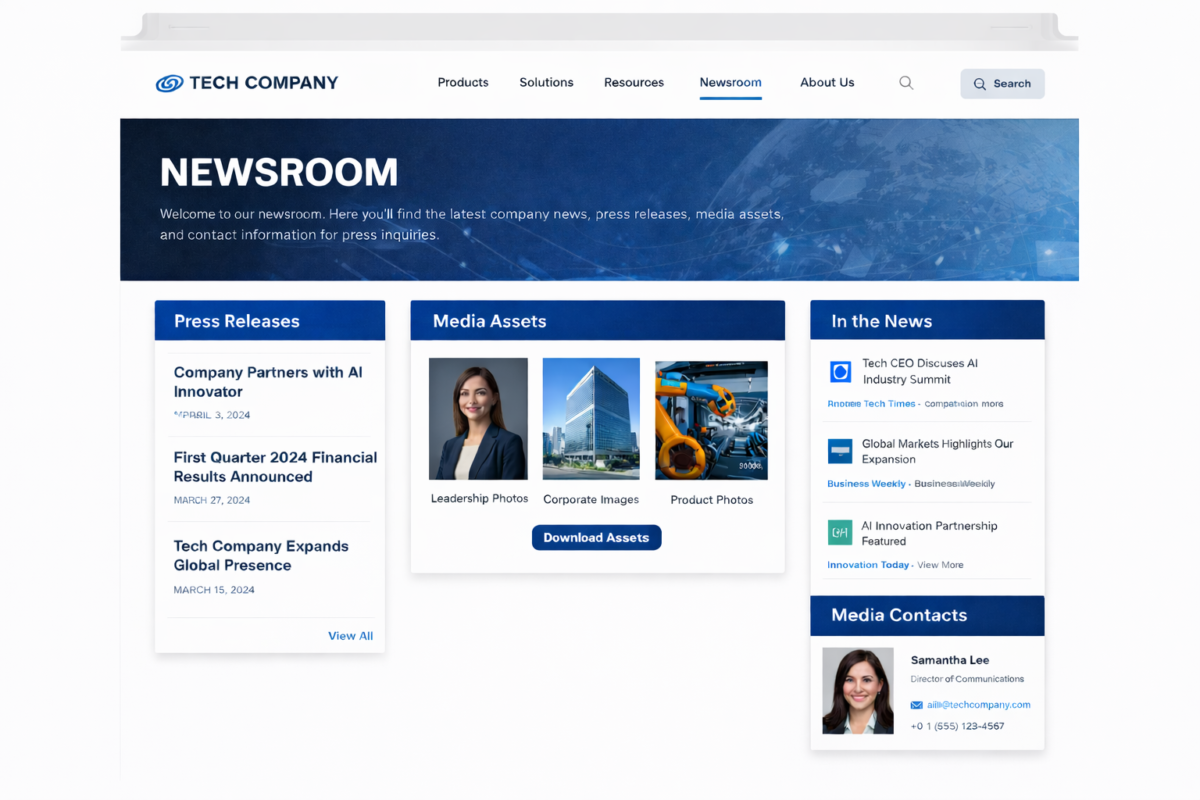
How B2B Brands Should Organize Their Newsrooms in the Age of AI

B2B brands’ newsrooms should be treated as governed, easily discoverable, and AI-ready communications infrastructure that serves journalists with authoritative information while acting as the primary reference point for how both humans and AI agents understand the company.

For B2B brands, the corporate newsroom has long served as a practical interface between the organization and the media. At its best, it functions as a reliable hub where journalists can quickly find verified information, past announcements, and visual assets that support accurate reporting.

In the age of AI, and more specifically large language models, the role of the newsroom is expanding. It still needs to serve human journalists efficiently, but it must now also serve machine readers that increasingly influence how brands are discovered, summarized, and cited. This dual audience raises the bar for how newsrooms are structured, formatted, and governed.

Discoverability and naming matter

At a fundamental level, a B2B newsroom should be designed to remove friction for journalists. When reporters arrive at a newsroom, they are typically looking for authoritative background information on the company, a clear archive of past news, and usable visual assets.

This also means the newsroom must be easy to find. Best practice is to label it clearly as “Newsroom” or “Press” and make it accessible from the main navigation or footer of the corporate website. Some brands place newsroom content under labels such as “Knowledge Center” or “Resources.” While that may make sense internally, it creates unnecessary friction for journalists. If reporters have to guess where to look, many simply will not. A newsroom that is difficult to locate or ambiguously named undermines its own purpose, particularly in fast-moving news cycles where speed and clarity matter.

Governing key company information

One of the most important functions of a newsroom is providing verified, up-to-date key information about the company. For B2B brands, this may include metrics such as the number of customers, transactions processed, locations served, markets active in, or other scale indicators relevant to the industry.

What matters most here is governance. Decisions about which metrics are shared publicly should be made consciously at the management level and reflected consistently across the newsroom. The newsroom should follow those decisions, not drive them. For non-public companies in particular, publishing metrics is a strategic choice with implications for competitive positioning and future communications. Once approved, the newsroom becomes the single source of truth, reducing the risk of conflicting figures appearing across press releases, interviews, and third-party coverage. In an AI-mediated information environment, this consistency is increasingly important.

Presenting data for reuse

Professional presentation matters, but flexibility matters more. Current best practice is to make key data available both as branded visualizations and as raw, machine-readable data files, typically CSV.

Branded charts help contextualize information and are useful for trade media and digital outlets that welcome ready-to-use visuals. At the same time, many tier-one outlets prefer to apply their own visual style and will not use branded graphics. Providing raw data allows journalists to work directly from the source and build their own visuals quickly and accurately.

To be truly usable, raw data should be well documented. Column headers should be clear, units of measurement explicit, and dates formatted unambiguously, for example using ISO 8601. This ensures datasets can be ingested and interpreted correctly across tools, markets, and time zones, by both humans and machines.

Editorial-grade visual assets

Visual assets remain a core newsroom component, but standards are often misunderstood. Images in a newsroom should be editorial rather than commercial in nature.

This includes leadership headshots, images of headquarters or key locations, and images that show the product or service in delivery or operation. All imagery should be professionally produced and suitable for editorial use. Staged poses, exaggerated smiles, and people looking directly into the lens should be avoided. The objective is credibility and usability, not brand advertising.

Best practice is to make images available in multiple sizes and resolutions so journalists can download what best fits their needs. It is also important to communicate clearly how images should be credited.

Video and b-roll for newsrooms

For broadcast and digital video outlets, b-roll is often as important as still imagery. Effective newsroom b-roll consists of short, clean clips, typically five to ten seconds per shot, that can be embedded seamlessly into news content.

Footage should be unbranded, with no logos, lower thirds, or titles burned into the video. Any embedded branding complicates reuse and reduces the likelihood that footage will be selected. As with still images, b-roll should be easy to download, clearly described, and organized so editors can quickly identify what they need.

Structuring press releases for retrieval

Press releases remain a cornerstone of newsroom content, particularly for B2B brands that rely on formal announcements. Releases should be easy to consult and easy to sort.

At a minimum, they should be timestamped and presented in reverse chronological order. Tagging releases by topic allows journalists to quickly filter announcements without scrolling through years of content. A well-structured archive respects journalists’ time and increases the likelihood that past announcements are referenced accurately.

Media contacts and spokesperson clarity

A newsroom should also make it clear how journalists can engage with real people. At a minimum, this means listing a dedicated media contact with name, role, and direct contact details.

Where appropriate, it can also be helpful to indicate which executives or subject-matter experts speak on which topics, such as strategy, technology, regulation, or operations. Even limited clarity here reduces friction and accelerates the path from inquiry to interview, particularly when AI-driven research prompts rapid follow-up.

Boilerplates as living documents

Company boilerplates are often treated as static text, but they are among the most reused elements of a newsroom. A modern newsroom should maintain both short and long boilerplates, written in clear, factual language and updated as the company evolves.

Changes in positioning, scope, or market focus should be reflected deliberately and consistently. For large language models in particular, boilerplates frequently become the default definition of what a company does. Treating them as living documents ensures that both journalists and AI systems work from an accurate, current description.

Citation guidance for proprietary content

Some organizations go a step further and include explicit guidance on how proprietary material may be cited by the media. This is particularly relevant for companies that publish original research, benchmarks, forecasts, or other intellectual property that journalists frequently reference.

A clear example of this approach can be found in Forrester’s publicly available Media Citations Policy, which explains how Forrester research may be quoted, attributed, and reproduced by external media, and where prior approval is required. By setting expectations upfront, Forrester reduces misquotation, protects its intellectual property, and supports more accurate reporting. B2B brands that invest heavily in proprietary content may benefit from providing similar citation guidance within their newsroom.

Linking to earned media

A newsroom can also serve as a record of earned media coverage. Linking to past articles, interviews, or broadcast segments provides validation and context.

Coverage should be linked to rather than copied, unless content has been explicitly licensed. In some cases, a short summary can be helpful, but even a simple link is often sufficient. The objective is visibility and verification, not duplication.

Crisis readiness and dark pages

A newsroom should be designed not only for routine announcements, but also for moments of scrutiny. Increasingly, organizations prepare a dark page, a prebuilt page that can be activated quickly in a crisis or emerging issue.

A dark page typically includes a holding statement, space for verified updates, links to authoritative information, and clear media contact details. Embedding this capability within the newsroom allows organizations to respond quickly without improvising under pressure. In an AI-driven environment, this readiness also helps ensure that accurate, controlled information becomes the primary reference point for both journalists and machines.

Optimizing for LLMs

Finally, newsrooms must now be optimized not only for search engines but also for large language models. This requires clear structure, consistent headings, explicit labeling of data and dates, plain-language explanations of what the company does, machine-readable formats for data and text, and a deliberate effort to ensure the newsroom serves as the canonical source for company facts.

As LLMs increasingly shape discovery, summaries, and citations, the newsroom becomes more than a media tool. It becomes a strategic visibility asset.

A core communications infrastructure

For B2B brands, a well-organized newsroom is no longer optional. It is core communications infrastructure that supports accurate journalism, reinforces credibility, and increasingly informs AI-mediated understanding of the company.

Brands that treat their newsroom as a governed, living system rather than a static archive will be better positioned to control their narrative, support the media, and remain visible and credible in an environment where both humans and machines decide what gets attention.

Categories
Company news

Detavernier Strategic Communication Joins German Network of Boutique Agencies

Detavernier Strategic Communication has joined Gartner’s Partners, a network of boutique PR agencies that supports German companies in expanding internationally.

Given the challenging economic conditions in Germany, many medium-sized companies are stepping up their international activities. To secure their future viability, they are exploring new export markets, outsourcing administrative tasks, and in some cases, relocating entire production sites.

Gartner’s Partners was founded as a global virtual network to provide professional strategic communication that minimizes reputational risk in the home market while supporting the development or expansion of strong corporate brands in target markets.

Key benefits for German companies working with the network:

  • Consistency: One point of contact for strategy, planning, and international coordination
  • Transparency: Streamlined administration (contract management, reporting, invoicing, etc.)
  • Effectiveness: Agile collaboration with local client teams for optimal execution
  • Quality: High-level consulting and execution driven by senior-level partners
  • Efficiency: Cost structures significantly lower than those of traditional network agencies

Gartner’s Partners is currently active in fourteen countries across all continents. Detavernier Strategic Communication serves as the network’s U.S.-based partner. All member agencies bring many years of experience in corporate communications and are well-versed in handling particularly complex challenges.

Photo by Mark König on Unsplash.

Categories
Uncategorized

How B2B Brands Can Newsjack Effectively

Newsjacking is one of the most effective ways for B2B brands to insert themselves into an active news cycle when it is done with discipline, speed, and genuine expertise.

At its core, newsjacking means contributing insight to breaking or fast-developing news stories that journalists are already covering. These developments can relate to economic shifts, regulatory decisions, corporate bankruptcies, technological breakthroughs, court rulings, or geopolitical events. When a brand can credibly add context, analysis, or foresight, it earns a legitimate place in the coverage.

What Newsjacking Looks Like in Practice

Consider a marketing firm that specializes in retail. A major retail chain files for bankruptcy. Within hours of the news breaking, the firm reaches out to relevant business and trade media to offer analysis. The pitch focuses on what the retailer did well and poorly from a marketing perspective, how consumer behavior shifted, and what other retailers can learn from the failure.

Because the firm contributes insight rather than promotion, journalists may include its perspective in their reporting. The result is increased visibility, credibility, and association with a timely and relevant news event. This outcome, however, rarely happens by chance. Effective newsjacking requires a deliberate process.

Defining the Topics You Can Credibly Own

Newsjacking starts well before any news breaks. Brands must first define the topics they are qualified to speak about, a task that typically belongs within a broader thought-leadership plan.

The topics selected should align with ongoing public conversations while also reflecting areas where the brand has genuine experience. Trending issues alone are not enough. Credibility matters, and journalists can quickly distinguish between informed analysis and opportunistic commentary. The strongest newsjacks come from brands that have helped clients navigate similar situations or have deep operational knowledge of the subject matter.

Turning Topics Into Followable News Targets

Knowing what topics to speak to is necessary, but it is not sufficient. Those topics must be operationalized by identifying concrete news developments that are likely to unfold in the future.

In the retail bankruptcy example, warning signs often appear well before the final filing. Declining earnings, store closures, layoffs, or analyst downgrades usually receive media attention first. These signals allow a brand to identify a specific company or situation to monitor closely. By selecting followable targets, brands move from abstract expertise to practical readiness.

Mapping Trigger Events in Advance

Following a target alone does not guarantee success. Brands also need to anticipate when the topic is likely to return to the news agenda.

This requires identifying trigger events that journalists are likely to cover. An economist seeking to comment on inflation, for instance, may focus on Federal Reserve interest-rate policy. In that case, scheduled FOMC meetings and rate announcements become predictable moments when media demand for expert analysis spikes.

Other trigger events include earnings calls, court decisions, regulatory deadlines, government votes, policy announcements, industry conferences, and data releases. Mapping these moments allows PR teams to prepare in advance rather than reacting after the story has already peaked.

Preparing Points of View and Quotes Ahead of Time

One of the most overlooked aspects of newsjacking is preparation. Experts should not wait until the news breaks to determine what they think.

A technology executive anticipating a government decision on AI policy, for example, should use the lead-up period to define a clear and defensible point of view. This preparation typically results in a concise explanation of what the development means, accompanied by one or more quotable statements. In many cases, it is prudent to prepare alternative versions that reflect different possible outcomes.

When the news finally breaks, the heavy lifting has already been done. A brief check-in with the expert may still be appropriate to ensure relevance, but the response can be immediate.

Packaging the Newsjack for Media Use

The format of a newsjacking pitch is intentionally simple. It usually consists of a short paragraph that outlines the expert’s perspective, followed by a clear, well-crafted quote. The pitch also invites journalists to follow up for an interview or an exclusive quote if they want to go deeper.

Clarity and speed are essential. Journalists covering breaking news do not have time for lengthy explanations or promotional language. The value must be immediately apparent.

Monitoring, Activating, and Distributing at the Right Moment

Execution is the final step in the process and rests largely with the PR team. This involves closely monitoring the news for the trigger event, alerting the expert that outreach is about to begin, confirming availability when interviews are likely, and distributing the pitch quickly and selectively to relevant media.

Timing plays a decisive role. Responding early, without speculating, significantly increases the likelihood that the insight will be included in coverage.

Knowing When Not to Newsjack

Not every news development presents a good opportunity for commentary. Discretion is essential.

There are situations where speaking publicly may be unwise or counterproductive, such as during sensitive lobbying efforts, regulatory negotiations, or legal proceedings. In other cases, adverse events affecting an entire industry may be better handled quietly, as additional commentary could amplify negative attention rather than contain it.

When Newsjacking Gets Confused With Ambulance Chasing

Newsjacking is most often confused with ambulance chasing when it takes place in the wake of adverse or negative events. That confusion is not inherent to the practice itself but to how it is executed.

Commenting on bankruptcies, court rulings, economic downturns, or other unfavorable developments is not inappropriate in itself. These events often have broad implications, and journalists actively seek expert analysis to help their audiences understand what happened, why it matters, and what it means for others.

The line is crossed only when commentary becomes self-serving, speculative, or designed to exploit misfortune rather than explain it. When analysis is factual, measured, and clearly aimed at adding context or insight, it is regarded as legitimate expert contribution rather than opportunistic pitching.

For B2B brands, the standard should be the same regardless of whether the news is positive or negative. If the contribution helps journalists do their job better and provides value to their audience, it is newsjacking done right.

Categories
Media trainings

Jo Detavernier will teach a media training course for CSCE in June

On June 26, Jo Detavernier will give a two-hour online workshop on mastering media interviews for the Centre for Strategic Communication Excellence.

The Centre for Strategic Communication Excellence is an Australian strategic communication training center offering on-demand, virtual, and in-person professional development programs. These programs are grounded in global best practices and align with the Global Standard of the Communication Profession, as well as the defined Career Paths of Communication Professionals established through extensive research by the International Association of Business Communicators.

The intensive two-hour workshop is designed to equip media spokespeople with the skills and strategies needed to successfully navigate media interviews. Participants will learn how to craft media messages aligned with their communication goals, manage interview dynamics, and handle common challenges. The training will cover both non-verbal and verbal communication techniques.

Course outline:

  • Overview of media message creation and alignment with communication goals
  • Introduction to message maps and other preparation tools
  • Verbal techniques: headlining, bridging, and flagging
  • Handling tough interview scenarios: loaded questions, interruptions, and speculative inquiries
  • Non-verbal communication essentials: appearance, vocal delivery, and body language
  • Rules of attribution: written and unwritten
  • Tailored approaches for different media channels (broadcast, print, online, Zoom, podcasts)

The course takes place on 26 November at 12:00 PM CT. Register through this link.

Categories
Uncategorized

The core components of a crisis communication plan for companies

A crisis communication manual translates a company’s intent to communicate in a crisis into clearly defined people, processes, and tools that allow it to engage the media effectively when it matters most.

Crisis communication plans are often confused with disaster recovery plans or broader crisis management plans. While these plans are related, they serve different purposes. Disaster recovery and crisis management plans focus on restoring operations, managing the operational response to an incident, and ensuring business continuity. A crisis communication plan focuses exclusively on communication with the media.

This applies equally to B2B and B2C companies. Both have brand credibility, trust, and legitimacy at stake when something goes wrong. Silence or poorly structured media communication damages confidence regardless of whether the audience consists of consumers, investors, regulators, or business partners.

Many organizations remain underprepared. According to Capterra’s Crisis Communications Survey, only 49% of U.S. companies have a formal, documented crisis communication plan in place.

Organizations without a plan are forced to improvise when a crisis hits. Improvisation under time pressure and uncertainty leads to slow, inconsistent, or contradictory messaging, which compounds reputational damage rather than containing it.

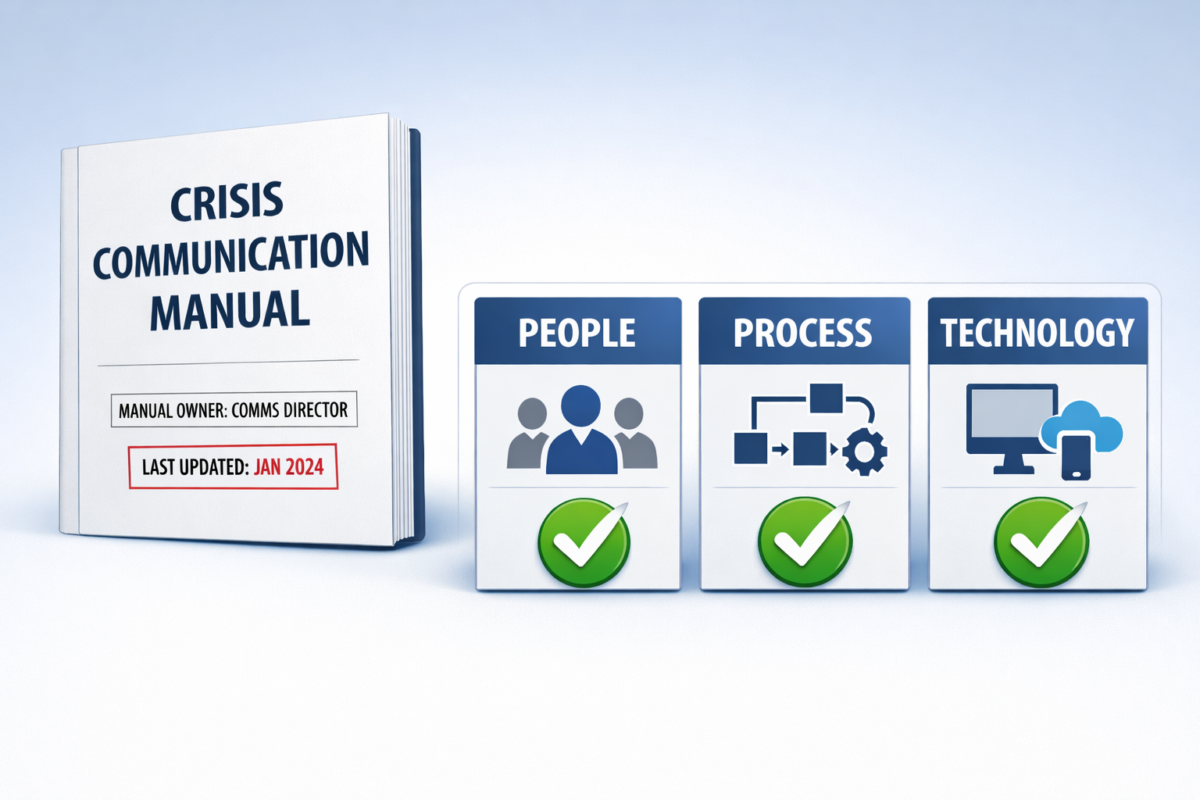
A crisis communication plan is operationalized through a crisis communication manual. This is the document an organization relies on under pressure. The manual must have a clearly designated owner responsible for keeping it up to date and must clearly indicate the date of its most recent update.

Operational and non-operational crises

Crisis communication manuals must support both operational and non-operational crises.

An operational crisis involves a physical impact on people, assets, or the environment. Examples include industrial accidents, safety incidents, environmental releases, or infrastructure failures.

A non-operational crisis involves no physical or criminal harm but threatens the organization’s credibility, trust, or license to operate. A typical example is an allegation of misconduct that triggers media scrutiny while day-to-day operations continue.

The nature of the crisis may differ, but the media communication machinery required to manage it should not.

What effective crisis communication is meant to achieve

Crisis communication is often discussed in terms of tone, such as empathy or reassurance. Tone matters, but crisis communication priorities are sequential.

The first priority is safety. In operational crises, media communication may be required to provide safety-instructing information that explains what is happening and what actions people should take. When physical risk exists, this information must come before expressions of empathy or statements about control and must be coordinated with public authorities.

The second priority is explanation. Once immediate safety concerns are addressed—or immediately in non-operational crises—the organization must acknowledge the situation and explain what is known. Media outreach and newsroom updates should address what happened, where it occurred, who is involved, and what is being done to establish the facts. When this need is not met, speculation fills the gap.

Reputation management follows safety and explanation. Expressions of empathy and reassurances of control are most effective after substance has been provided. Credibility is preserved through consistent, accurate updates rather than premature claims of control.

A scenario-agnostic crisis communication manual

A crisis communication manual should be scenario agnostic.

It should not be written around specific incidents. The processes it defines, the task distribution within the crisis communication team, and the tools it provides must work across operational and non-operational crises alike.

The manual must be treated as a living document. Ownership and a visible update history prevent contact details, access credentials, and procedures from becoming obsolete.

The crisis communication manual: people, processes, and technology

A crisis communication plan becomes executable through a manual structured around people, processes, and technology.

People

The manual must define the crisis communication team, including responsibilities, decision authority, reporting lines, and backups. Typical roles include:

  • crisis communication leader
  • liaison with operational management teams
  • media call taker
  • copywriter
  • distributor of statements and updates
  • note-taker
  • owner of the website newsroom CMS
  • on-site spokesperson, where relevant

Not every organization needs a separate individual for each role, but every role must be covered. Spokesperson readiness should be addressed through regular media training and refreshers.

Process

The manual must define how crisis communication is executed under pressure, including:

  • how the crisis communication team is activated
  • who can declare a communications crisis
  • escalation paths and approval workflows
  • information flow from operational teams to media messaging
  • validation of updates as facts evolve
  • media monitoring and assessment
  • identification and correction of misinformation
  • criteria for declaring the crisis “off” from a media relations perspective
  • review and update cycles for the manual itself

Clear processes reduce friction when time and clarity are most constrained.

Technology

The technology pillar covers the tools and resources required to operate effectively under pressure:

  • a single media inquiry intake and routing mechanism
  • a pre-approved holding statement repository
  • templates, message maps, and factsheets
  • a media distribution system, including wire services
  • press briefing infrastructure with backup options
  • a pre-curated media asset library linked to the newsroom CMS
  • a knowledge map identifying internal subject-matter owners
  • version control for all approved materials
  • archiving and audit trails for media-facing content
  • login credentials and access instructions for all systems used

The manual must also define technology substitutes and fallback options. Systems can fail during a crisis. If a media CRM or distribution platform is unavailable, the manual should specify which alternative system can be used, such as a monitored corporate media inbox.

An important end note: preparation requires practice

Crisis communication manuals are necessary but insufficient. They do not prepare an organization on their own.

Preparation requires regular desktop exercises and drills that train people to execute the roles, processes, and tools defined in the manual. Without practice, even a well-designed crisis communication plan remains theoretical.

Categories
Media trainings

Jo Detavernier will be teaching two courses at Let’s Talk Science

Jo Detavernier will teach two distinct courses on media training.

Let’s Talk Science is an annual event at which Flemish universities and non-university institutes of higher education help their researchers hone their communication skills. This year, the event takes place from 1 to 3 July and is hosted by KU Leuven.

Jo Detavernier will lead the following two sessions at the 2025 edition of Let’s Talk Science:

A Survival Guide to Efficient Media Interviews

This session will equip participants with the skills needed to conduct effective media interviews. It will cover essential verbal and non-verbal delivery techniques, including headlining, flagging, and bridging. The content has been co-developed with the renowned British behavioral science consulting agency, Communication Science Group, ensuring an evidence-based approach.

Participants will learn how to:

  • Prepare effectively for media interviews (15% of the session)
  • Communicate their messages clearly and persuasively (80% of the session)
  • Follow up with journalists after the interview (5% of the session)

Using ChatGPT to Prepare for Your Media Interview

This hands-on bootcamp will demonstrate how participants can use ChatGPT to prepare for media interviews. Key use cases include researching journalists and their publications, refining key messages, and anticipating tough questions.

Participants will gain practical insights into leveraging ChatGPT for media interview preparation.

The courses are not open to the public. However, Detavernier Strategic Communications is available to deliver tailored training sessions covering the content of both courses for organizations and companies seeking to train and prepare their communicators for media interviews. Contact us today for more information.