Message maps help spokespeople approach media interviews with clarity and confidence by defining in advance what they want to communicate and why.
Media interviews are a powerful way for company leaders to position their organizations. They offer visibility, credibility, and the opportunity to speak directly to clients, prospects, investors, and other stakeholders through trusted third parties. When they go well, media interviews can meaningfully strengthen a company’s reputation.
At the same time, media interviews can be challenging. They put spokespeople under pressure. Questions come quickly, answers are public, and there is little room to correct missteps once something has been said. In that environment, even experienced leaders can find themselves reacting to questions rather than communicating deliberately.
Why Preparation Matters More Than the Right Questions
For that reason, spokespeople do well to carefully prepare the messages they want to convey in media interviews in advance. If they fail to do so, the success of their media performance becomes dependent on the journalist asking the “right” questions. This is a risky strategy, not because journalists are careless, but because their role is not to help the spokesperson structure their message. Their role is to serve their audience.
From the spokesperson’s perspective, this creates an additional challenge. Media interviews impose cognitive pressure. People must listen carefully, formulate answers quickly, and manage how they come across, all at the same time. Under these conditions, spokespeople tend to respond reactively. They focus on answering the question in front of them rather than on advancing the messages they want their audiences to take away. This is where message maps come in.
What a Message Map Does
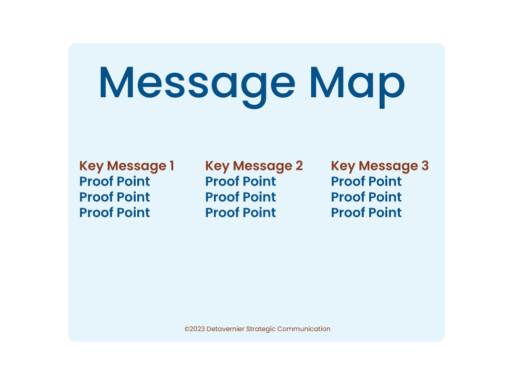
Through a message map, all key messages a spokesperson plans to convey in a media interview are laid out in advance. These messages are selected in function of the communication objectives the spokesperson wants to achieve. Those objectives will always relate to changing how at least one group of stakeholders knows, feels, or acts in relation to the topic at hand.
Consider a company that wants clients, prospects, and potential investors to understand that it is growing rapidly and that further growth lies ahead. Media messages at the start of the year could include one key message about strong organic growth in the previous year, and a second key message about strategic investments made to sustain growth in the coming year. The message map ensures that these points are top of mind before the interview begins, rather than being recalled opportunistically during it.
The Limits of Attention: Fewer Messages, Greater Clarity
Because people can only retain a limited number of ideas at once, message maps typically contain no more than three to five key messages. This limit is not arbitrary. When messages are clearly structured and rehearsed in advance, they are easier to retrieve under pressure. In that sense, a message map functions less as a script and more as a mental guide that reduces the effort required during the interview itself.
Credibility Requires Proof Points
For key messages to be perceived as credible, they also need to be supported by facts and figures. Specifics matter. Audiences tend to trust concrete statements more than general ones, even before verifying them. Numbers, timelines, and clearly defined actions signal seriousness and preparation.
Returning to the growth example, an organization that claims it has made strategic investments must be prepared to share at least a minimum level of detail. This could include the type of investments made, the scale of those investments, or the areas they are intended to strengthen. Without such specifics, key messages risk sounding vague or gratuitous.
Staying Anchored Under Pressure
Message maps also help spokespeople avoid a common pitfall in interviews. When faced with a difficult or unexpected question, people often answer a simpler version of that question rather than the one that best serves their objectives. A message map counteracts this tendency by keeping the spokesperson anchored to what matters most, even when the question itself offers limited opportunity to do so.
From Improvisation to Direction
In conclusion, spokespeople who are equipped with a thoughtfully constructed message map enter media interviews with a clear sense of direction. They are less dependent on the journalist’s line of questioning and better able to place their key messages and proof points where they belong. As a result, they tend to deliver clearer, calmer, and more effective media performances than interviewees who rely on improvisation alone.
Interested in learning more about evidence-based tips for effective media interviews? On 2 April, Jo Detavernier will host a webinar featuring 100 practical tips for successful media interviews. More information on the content and registration can be found here.