Categories
Media trainings

Jo Detavernier will teach a media training course for CSCE in March

On March 27, Jo Detavernier will give a two-hour online workshop on mastering media interviews for the Centre for Strategic Communication Excellence.

The Centre for Strategic Communication Excellence is an Australian strategic communication training center offering on-demand, virtual, and in-person professional development programs. These programs are grounded in global best practices and align with the Global Standard of the Communication Profession, as well as the defined Career Paths of Communication Professionals established through extensive research by the International Association of Business Communicators.

The intensive two-hour workshop is designed to equip media spokespeople with the skills and strategies needed to successfully navigate media interviews. Participants will learn how to craft media messages aligned with their communication goals, manage interview dynamics, and handle common challenges. The training will cover both non-verbal and verbal communication techniques.

Course outline:

  • Overview of media message creation and alignment with communication goals
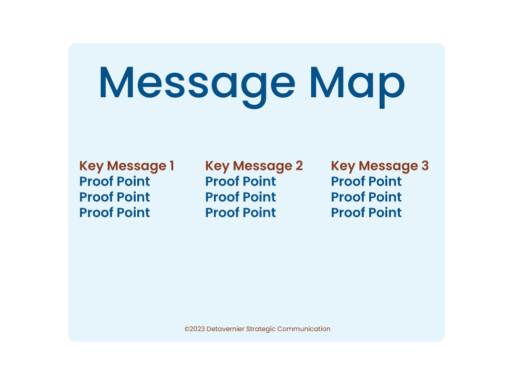
  • Introduction to message maps and other preparation tools
  • Verbal techniques: headlining, bridging, and flagging
  • Handling tough interview scenarios: loaded questions, interruptions, and speculative inquiries
  • Non-verbal communication essentials: appearance, vocal delivery, and body language
  • Rules of attribution: written and unwritten
  • Tailored approaches for different media channels (broadcast, print, online, Zoom, podcasts)

The course takes place on 27 March at 5:00 PM CT. Register through this link.

Categories
Management skills

How RACI Helps PR Teams Succeed

RACI helps PR teams avoid unforced errors by clearly defining who is responsible, accountable, consulted, and informed for each task, enabling faster execution and smoother collaboration.

Both B2B and B2C PR teams are under constant pressure to be effective and efficient. Resources are limited, deadlines are tight, and internal clients are demanding. Under those conditions, teams can ill afford unforced errors: time lost because responsibilities were unclear, approvals were missed, or key colleagues were left out of the loop.

These gaps show up in very practical ways. People fail to inform the right colleagues about the progress of an assignment. Team members do not realize that others are counting on them to complete a specific task. Work moves forward without an approval that should have been obtained. None of this reflects a lack of professionalism or intent. It reflects a lack of structural clarity around who does what.

What makes this particularly frustrating is that the solution is not new. The RACI model has its origins in management thinking from the 1950s, when organizations began formalizing responsibility structures to cope with growing scale and complexity. Decades later, that same logic remains highly relevant for modern PR teams juggling multiple stakeholders, channels, and fast-moving news cycles.

What Is RACI?

RACI is a framework for clarifying roles and responsibilities within a project or process. It assigns four possible roles to each task:

  • Responsible
    The person who does the work.
  • Accountable
    The person who owns the outcome and has final decision-making authority.
  • Consulted
    People whose input is required before the task is completed.
  • Informed
    People who need to be kept up to date but are not directly involved in execution or decision-making.

For RACI to be effective, there needs to be agreement among the relevant internal stakeholders on how these roles are assigned. The value of RACI lies in shared understanding, not unilateral task allocation.

The strength of RACI lies in its clarity. For every task, it answers four essential questions: who does the work, who decides, who needs to be consulted, and who needs to be kept informed.

Why PR Teams Are Vulnerable Without RACI

PR work is inherently collaborative and cross-functional. A single deliverable such as a press release often involves PR, legal, marketing, executive leadership, and sometimes investor relations or HR. Without explicit role definition, assumptions fill the gaps.

This leads to predictable friction. Colleagues assume someone else is handling updates, approvals are delayed because ownership is unclear, and key stakeholders are consulted too late in the process. Executives may find themselves surprised by coverage they should have anticipated. In high-pressure environments, these issues compound quickly, consuming time and attention that could have been spent on execution.

RACI does not eliminate complexity, but it makes complexity manageable by replacing assumptions with clarity.

One Accountable and At Least One Responsible

A critical rule when applying RACI is that every task must have at least one person who is Responsible. If no one is clearly responsible for execution, the task will stall or fall between the cracks.

Each task should also have one Accountable person who owns the outcome and has final decision-making authority. When accountability is shared, it tends to be diluted.

In the day-to-day operations of a PR department, having one clearly designated Responsible owner per task is both advisable and feasible. PR work moves fast, dependencies are tight, and ambiguity around execution quickly translates into delays, rework, and missed deadlines. Clear responsibility keeps work moving and creates a natural point of coordination.

Consulted and Informed roles remain essential, but clarity around responsibility and accountability prevents confusion downstream.

A Practical Example: A B2B Technology Funding Announcement

Consider a B2B technology company preparing to announce a significant funding round. While this may appear to be a single PR moment, it consists of multiple interconnected tasks, among others:

  • Drafting the press release
  • Securing executive quotes
  • Legal review and compliance checks
  • Media list development
  • Distribution of the press release
  • Website update
  • Follow-up with journalists

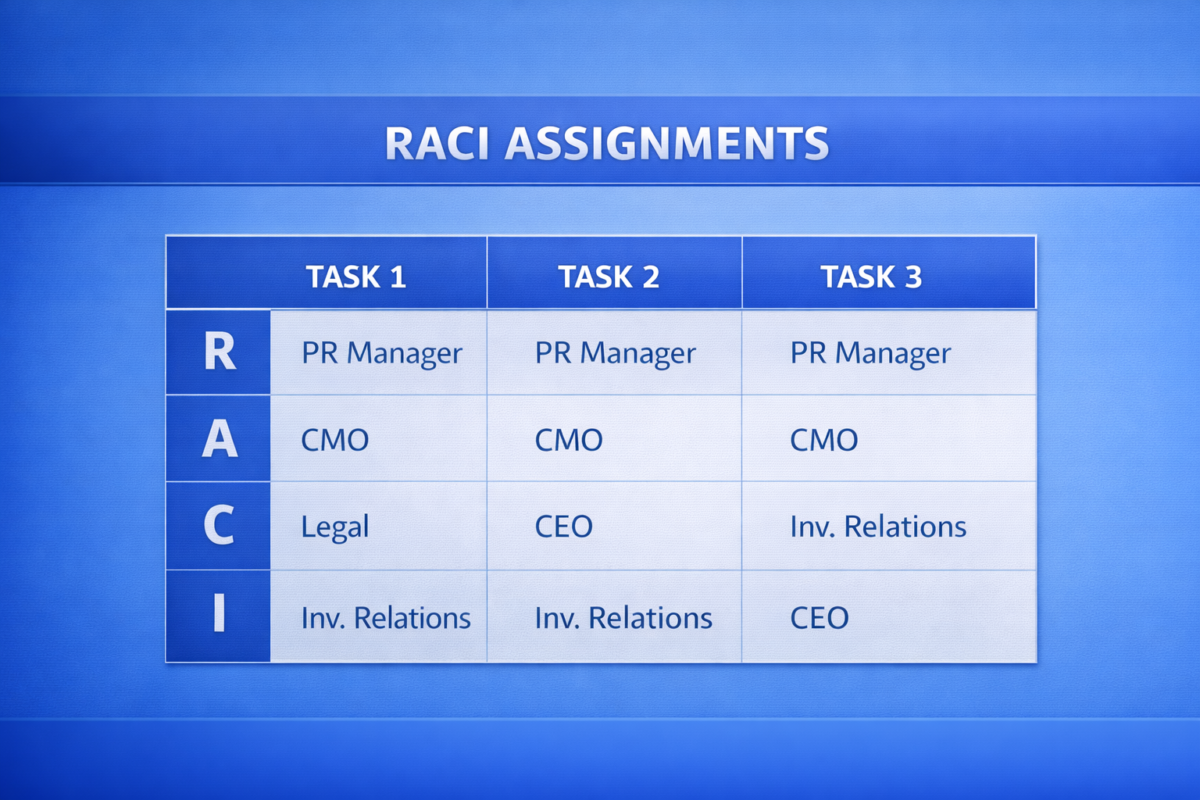
Using a RACI matrix before work begins allows the team to map responsibilities across these tasks clearly.

For example:

  • Responsible (R)
    The PR lead or PR manager executes the work. This includes drafting the press release, coordinating executive quotes, developing the media list, distributing the release, updating the website, and following up with journalists.
  • Accountable (A)
    The CMO is accountable for the funding announcement as a whole and signs off on final messaging, timing, and execution.
  • Consulted (C)
    Legal is consulted on disclosure language and compliance requirements.
    The CEO is consulted on positioning and executive quotes.
  • Informed (I)
    Investor Relations is informed ahead of distribution and follow-up to prepare for inbound questions from analysts and investors.

By documenting these roles upfront, the team removes ambiguity. Everyone knows who is doing the work, who owns the outcome, who needs to be consulted, and who needs to be kept informed.

RACI as a Planning Tool

RACI works best when it is used proactively during planning rather than after problems arise.

It also does not need to be bureaucratic. A simple table mapping tasks to roles is often sufficient. The goal is not documentation for its own sake, but shared understanding.

For PR leaders, RACI helps manage expectations with internal clients. When responsibilities are explicit, it becomes easier to explain timelines, approval steps, and dependencies.

A Small Investment With Outsized Returns

PR success depends not only on creativity and media savvy, but on execution discipline. Missed approvals, unclear ownership, and poor internal communication consume time and energy without adding value.

RACI helps PR teams avoid these unforced errors. By clarifying who does what, who decides, who advises, and who needs to be kept informed, teams can move faster, reduce friction, and focus on delivering results.

In an environment where resources are tight and expectations are high, that clarity is a competitive advantage.

Categories
Media trainings

How to Media Train the CEO

Media training for the CEO is a structured, realistic process that aligns message discipline, delivery skills, and thought leadership persona to ensure the CEO communicates with authority and strategic intent when it matters most.

The CEO is the spearhead of a company’s strategic communication. When it matters most, it is the CEO who speaks. Not frequently, but deliberately. Major announcements, defining moments, crises, and long-term positioning all require the authority, credibility, and visibility that only the CEO can provide. This makes every media interaction involving the CEO consequential and places a high bar on preparation.

Media training for a CEO is relevant at any stage of experience. It can support a newly appointed leader who is still finding their footing with the media, as well as a seasoned CEO who has given countless interviews. Depending on the experience of the CEO, some of the elements described below will receive more or less emphasis. In all cases, the objective is not to teach someone how to talk, but to sharpen performance, reinforce consistency, and ensure that media appearances actively support the company’s strategic objectives.

Two inputs are essential to effective CEO media training: an assessment of past performance and an assessment of the CEO’s thought leadership persona.

Assessing Past Performance

Past media appearances provide a concrete and objective starting point. They reveal strengths to build on and weaknesses that need attention, both in delivery and, where visible, in message design.

On the verbal level, common issues include difficulty handling negative questions, losing structure when interrupted, over-answering, or drifting away from key messages under pressure. Some CEOs become defensive when challenged. Others struggle to close answers decisively or to regain control once a journalist reframes the discussion.

Non-verbal performance is equally important. Pacing may be rushed or overly measured. Eye contact may be inconsistent. Posture and composure can unintentionally signal uncertainty or defensiveness. Even in print or online interviews, vocal delivery, rhythm, and emphasis influence how messages are perceived. Reviewing past performance allows these elements to be identified and addressed in a targeted way.

Defining the Thought Leadership Persona

Beyond technique, a CEO’s media presence is shaped by how they are perceived as a thought leader. Thought leadership comes in many forms, and it is useful to acknowledge this explicitly at CEO level. This persona does not emerge arbitrarily, but reflects a communication style the CEO has consciously or implicitly chosen because it feels authentic and comfortable.

A CEO who communicates primarily as an evangelist will typically emphasize conviction, momentum, and belief, while a CEO who leans more toward a visionary posture may place greater weight on long-term direction and strategic intent. These are only two possible examples of thought leadership style.

The thought leadership persona does not replace or override the company’s message architecture. Primary messages, supporting messages, proof points, and factual guardrails remain constant. It does however influence which proof points are foregrounded, how examples are framed, how much emphasis is placed on ambition versus execution, and the tone in which messages are delivered.

If the thought leadership persona of the CEO has never been communicated to them in explicit terms, the trainer will follow the persona that comes closest to the CEO’s implicit communication style, as observed in past media appearances and early interactions during the training.

Making Media Training Realistic

Media training is only effective if it feels real. This requires simulated interviews that mirror actual media interactions and are grounded in real business developments.

Executives are rarely interviewed without context. Journalists typically approach them with a topic, an angle, or a reason for the conversation. Training should reflect that reality. Ahead of the session, the CEO should receive two interview requests for as many simulated interviews. These requests are handled by the trainer or a co-trainer acting as journalists. They outline the topic and indicate some of the questions that may be asked, but not all of them.

Ideally, these interviews relate to a specific announcement that is being prepared. This increases realism and engagement and encourages the CEO to invest effort in the exercise. It also allows the CEO to work from a draft press release or an existing message map, mirroring real-world preparation.

Interview requests are typically shared three to four working days before the training session.

Structure of the Training Session

A CEO media training usually lasts between ninety minutes and two hours. Theory and practice are interwoven. The CEO speaks, learns, applies, and speaks again.

From a practical perspective, CEOs are best trained individually. Media training is demanding, and few executives benefit from making mistakes in front of the CEO. If budget constraints require a group setting, participants should be at a comparable seniority level.

The session often begins with a concise overview of how the media operate, what journalists look for, and how interviews fit into the broader media ecosystem. This establishes context without overwhelming the trainee.

A first simulated interview follows quickly. Trainers should design this interview in a way that allows the CEO to make mistakes. Learning is most effective when it emerges from experience rather than instruction.

The Hot Debrief

Immediately after the first interview, a hot debrief takes place. The CEO is asked to reflect on their own performance before receiving external feedback. This approach increases ownership of the learning process and improves receptiveness to coaching.

At this stage, the trainer also assesses how the CEO prepared for the interview. If the CEO did not work from clearly defined key messages and proof points, this moment is used to introduce the message map as a preparation tool. The trainer explains how key messages are structured, how proof points support them, and how this framework helps maintain control during interviews. When the CEO is asked to develop a message map, it goes without saying that they are invited to do so with the support of the Director of PR or another senior communications leader, if such a person is available (see also later).

The trainer then adds observations, explanations, and targeted guidance, supported by video playback of specific moments. Recording the interview allows for precise feedback and avoids reliance on memory alone, particularly when a single trainer conducts both the interview and the evaluation.

Teaching Core Media Techniques

Even in the first interview, trainers typically introduce foundational techniques.

Bridging teaches the CEO how to transition from a question to key messages, regardless of whether the question is positive, neutral, or negative. Headlining focuses on leading with the core message before supporting it with proof points. Flagging emphasizes the use of explicit signals to indicate what matters most.

These techniques are reinforced through repeated application rather than abstract explanation.

Increasing Complexity

The second simulated interview is usually more demanding than the first. Trainers introduce interruptions, loaded questions, and false dilemmas that force unacceptable alternatives. Performance again drives learning. Effective techniques are acknowledged and reinforced. Weaknesses are addressed with clear, actionable guidance.

If the CEO did not arrive with prepared key messages for subsequent interviews, additional preparation time is built in. Typically, an extra five minutes are given before the second and third interviews for the CEO to prepare using the message map introduced during the hot debrief. This preparation can again be done with the support of the Director of PR or another senior internal communications leader, if available.

Ideally, a third simulated interview follows. It is not more complex than the second, but it allows the CEO to apply what has been learned and to finish with a markedly stronger performance than at the start. Media interviewing is a skill, not a talent, and visible improvement reinforces confidence and motivation.

Understanding Different Media Formats

Simulating interviews across different formats helps the CEO understand the varying demands of different media. Print and online interviews place greater emphasis on clarity, structure, and quotability, while on-camera interviews add layers of non-verbal communication, composure, and presence.

Experiencing both formats during training allows the CEO to appreciate how answers must be adapted without compromising message integrity. The trainer actively guides the CEO through these differences and helps them navigate the expectations of each medium.

Multi-Channel Learning and Multimedia Reinforcement

From a learning perspective, the training deliberately follows a multi-channel approach. Learning is more effective when information is processed through different cognitive channels rather than through words alone. Live interaction, spoken feedback, and video recordings activate complementary forms of processing.

Recording the CEO’s own performance already engages multiple channels by combining verbal content with visual and non-verbal cues. Adding short video clips of other CEOs demonstrating effective and ineffective techniques provides additional content for visual processing. These clips create reference points that support comparison and pattern recognition, helping the trainee internalize best practices more quickly.

This multi-channel exposure strengthens retention and transfer. The CEO does not only hear what works or review their own performance, but also observes how similar techniques are executed by others, which accelerates assimilation and sharpens judgment.

Written and Unwritten Rules of Media Interviews

An effective CEO media training also covers the written and unwritten rules that govern media interviews.

This includes a clear explanation of what it means to speak on the record, off the record, and on background, and how these distinctions are applied in practice. CEOs need to understand that these terms are not interchangeable and that assumptions about confidentiality can lead to misunderstandings if not explicitly agreed upon.

The trainer also explains how media embargoes work, including why journalists use them, how they are honored, and what risks arise when embargoes are misunderstood or broken. This knowledge helps the CEO navigate complex media situations with confidence and protects the organization from unintended disclosure.

Institutional Alignment and Follow-Up

While it is generally not advisable to train multiple people during the interviews themselves, it is valuable to involve a senior communications leader such as a Director of PR or another internal communications leader in the session. This person can support feedback on messages and proof points and ensure alignment with existing communication policies and frameworks.

If such a representative cannot be present, the trainer must be briefed in advance on existing messaging frameworks, from message maps to message catalogues. These frameworks act as guardrails against which the CEO is trained.

An effective CEO media training combines realistic simulation, structured feedback, escalating challenge, and institutional alignment into a single, coherent learning experience.

An effective follow-up includes a personalized one-page debrief summarizing strengths, improvement areas, and practical guidance for future interviews. Learning is further enhanced by incorporating multimedia examples, such as short clips of other CEOs demonstrating effective and ineffective use of the techniques covered.

Media training at CEO level is not about scripting or performance for its own sake. It is about ensuring that when the CEO speaks, selectively and with intent, their presence advances the company’s strategy, credibility, and long-term positioning.

Categories
Media trainings

Jo Detavernier conducts media training course for CSCE in November

On November 19, Jo Detavernier will give a two-hour online workshop on mastering media interviews for the Centre for Strategic Communication Excellence.

The Centre for Strategic Communication Excellence is an Australian strategic communication training center offering on-demand, virtual, and in-person professional development programs. These programs are grounded in global best practices and align with the Global Standard of the Communication Profession, as well as the defined Career Paths of Communication Professionals established through extensive research by the International Association of Business Communicators.

The intensive two-hour workshop is designed to equip media spokespeople with the skills and strategies needed to successfully navigate media interviews. Participants will learn how to craft media messages aligned with their communication goals, manage interview dynamics, and handle common challenges. The training will cover both non-verbal and verbal communication techniques.

Course outline:

  • Overview of media message creation and alignment with communication goals
  • Introduction to message maps and other preparation tools
  • Verbal techniques: headlining, bridging, and flagging
  • Handling tough interview scenarios: loaded questions, interruptions, and speculative inquiries
  • Non-verbal communication essentials: appearance, vocal delivery, and body language
  • Rules of attribution: written and unwritten
  • Tailored approaches for different media channels (broadcast, print, online, Zoom, podcasts)


The course takes place on 19 November at 5:00 PM CT. Register through this link.

Categories
Media trainings

Jo Detavernier hosts webinar on preparing the C-suite for media interviews

On 24 October 2024, Detavernier Strategic Communication organizes a webinar on how communication and marketing professionals can beest prepare their C-suite to media interviews.

The webinar has been designed to help communication and marketing professionals better prepare their C-suite for media interviews.

Jo Detavernier will lead the session, which will be divided into two parts: the first will focus on organizing effective media training sessions for leaders, while the second will provide best practices for ongoing support and preparation for media engagements.

Two of Detavernier Strategic’s expert media trainers will join as guest speakers. Ray Young will discuss optimal preparation for broadcast media interviews, while Sabine Steen-Lakerveld will explore the differences between media interviews in Europe and the United States.

The webinar will cover:

Media trainings

  • Structuring the flow of a media training session
  • Techniques for designing key messages
  • Essential verbal and non-verbal delivery skills
  • Sourcing third-party vendors for media training

Daily media management

  • Coaching and preparing leaders for interviews
  • Staffing interviews effectively
  • Post-interview follow-up procedures

The webinar is open to in-house PR, marketing, and corporate communication directors and managers. It will take place from 10:30 AM to 11:30 AM on October 24, 2024.

Click here to register today.

Categories
Crisis communications

Jo Detavernier shares “three things” on the Centre for Crisis and Risk Communications vlog

Jo Detavernier shared three important insights on evidence-based crisis communications on the vlog.

The Centre for Crisis and Risk Communications is a Canadian crisis management training center that works closely with Vincent Covello. The centre offers real-time crisis communication assistance, tools, training, and workshops.

The centre’s managing director and principal is Benjamin Morgan, a seasoned crisis communications specialist who has helped Canadian authorities manage the 2013 Calgary floods and the 2016 Fort McMurray wildfire, among other events.

Mr. Morgan also hosts the Centre’s vlog, where guests share three important insights on a crucial crisis communications topic. When Jo Detavernier was a guest on the vlog, he provided three insights on evidence-based crisis communications.

A deeper elaboration on the insights he shared can be found in the second edition of the Handbook on Crisis Communications (W. Timothy Coombs and Sherry J. Holladay, eds.).

A deeper elaboration on the insights he shared can be found in the second edition of the Handbook on Crisis Communications (W. Timothy Coombs and Sherry J. Holladay, eds.).

Categories
Company news

Detavernier Strategic Communication Supports Third Economy

Detavernier Strategic Communication has been engaged to support Third Economy in increasing awareness of the firm’s ESG consulting capabilities.

As part of this engagement, Detavernier Strategic Communication will pitch thought leadership content and expert commentary from Third Economy’s leadership to American trade and business media. The objective is to increase awareness among investors, corporate sustainability teams, and executive decision-makers seeking experienced ESG advisory partners.

About Third Economy

Third Economy is a U.S.-based ESG consulting firm that has been working with investors and corporations since 2018 to advance sustainability capabilities and support the development of sustainable investment portfolios. The firm empowers its clients with insights designed to drive profitability while generating positive environmental and social impact, contributing to the acceleration of a more sustainable global economy.

The firm’s name reflects an emerging economic era grounded in sustainability, following the pre-industrial and industrial ages, and also references the Earth as the third planet from the sun. Third Economy was founded by Chad Spitler, who brings more than 20 years of institutional investing and sustainability consulting experience.

Prior to founding Third Economy, Mr. Spitler served as a Managing Director at BlackRock, where he helped establish the firm’s Investment Stewardship and Sustainable Investing teams. His work focused on analyzing how ESG factors impact financial performance and integrating those insights into investment decisions, engagement, proxy voting, and product development.

While headquartered in the United States, Third Economy’s work takes place across North America—including Mexico and Canada—as well as Latin America and Europe, enabling the firm to apply cross-market perspective to ESG strategy, corporate sustainability, and responsible investment.

Strategic Media Engagement

Detavernier Strategic Communication’s work will focus on positioning Third Economy’s leadership as expert voices in discussions related to the firm’s expertise, including ESG strategy, corporate sustainability, investment stewardship, and sustainable investing. Through targeted engagement with American trade and business media, the campaign aims to strengthen awareness of Third Economy among buyers evaluating ESG expertise.

This engagement reflects Third Economy’s continued focus on its core advisory work and Detavernier Strategic Communication’s experience supporting consultancies as they build credibility and awareness with American audiences.

Image disclaimer: The stock image used in this article is for illustrative purposes only and does not depict Third Economy offices, facilities, or employees.

Categories
Crisis communications

Jo Detavernier to conduct a PRSA webinar on evidence-based crisis communication

On May 15, 2024, Jo Detavernier will conduct a PRSA Learning Webinar on evidence-based crisis communication.

In the webinar, Jo will provide an introduction to established and emerging crisis communication research. Among the established theories he will discuss the Situational Crisis Communication Theory, as well as the Stealing Thunder Theory. The former is instructive about how organizations should communicate critical news while the latter elaborates on when they should communicate it.

His venture into research from emerging and adjacent fields of academic inquiry will also cover recent findings on the impact of vocal cues on crisis communication efficiency, along with insights into how crisis-biased heuristics can lead communicators astray (and what communicators can do to prevent this from happening).

Finally, Jo will also discuss how practitioners can incorporate an evidence-based approach to crisis communications in their crisis communication plans and training programs.

The webinar’s content expands on the contribution Jo wrote in the second edition of the Handbook of Crisis Communications that was published by John Wiley & Sons in 2023.

More information on the webinar can be found on the registration page. The webinar is available to both members and non-members.

Categories
Corporate communications

Corporate Activism: How Companies Should Decide When to Take a Stand

A disciplined decision framework for corporate activism focuses on values, credibility, stakeholder impact, and measurable objectives.

This article is a shortened and simplified version of a longer contribution to Corporate Activism: Research, Case Studies and Solutions for Communicators to Address a Rising Trend, published by Quadriga University in 2021 and edited by Ana Adi.

Corporate activism is all the rage in the United States. From climate change and immigration to LGBTQ+ rights, gun policy, and social justice, companies across many sectors are increasingly expected to take public positions on issues that appear, at least at first glance, to have little to do with selling products or maximizing shareholder value. In some cases, the motivation behind these moves is clear. In others, it is far less obvious what companies are trying to accomplish or whether their actions are principled, strategic, opportunistic, or reactive.

This development applies not only to consumer brands, which tend to receive the most public attention, but equally to B2B companies. Enterprise software firms, manufacturers, professional services providers, and industrial brands face growing expectations from employees, customers, partners, and policymakers to articulate where they stand on social and political issues. While the visibility and immediacy of public reaction may differ between B2C and B2B contexts, the underlying strategic questions are largely the same.

There is no consensus among business leaders on whether companies should pursue a purpose beyond profit maximization. There is even less agreement on whether companies should engage in corporate activism, an approach that represents the most visible expression of a purpose-driven strategy.

Some critics reject this approach outright. Marketing scholar Byron Sharp has argued that companies should remain profit seekers first and foremost and that pursuing causes not clearly centered on profit maximization risks being unethical. Others believe companies have a responsibility to use their influence to advance social progress.

Rather than revisiting that philosophical debate, this article approaches corporate activism from a practitioner’s perspective. It examines how leadership teams can assess whether taking an activist stance on a particular issue is advisable. The objective is not to explain why employees or customers push companies to act, but to offer a structured decision framework that supports informed leadership deliberation.

The framework consists of five questions that should ideally be answered positively, and in the order presented, before a company proceeds with a corporate activist stance. While the examples discussed focus primarily on the United States, the framework itself is broadly applicable.

Defining Corporate Activism

Corporate activism is often conflated with other forms of corporate engagement, making clear definitions essential. Corporate activism must be distinguished from Corporate Social Responsibility. CSR refers to a company’s efforts to understand and mitigate the impact it has on its surroundings. A food manufacturer investing in sustainable sourcing or a logistics company reducing emissions is acting as a responsible corporate citizen. Such initiatives are typically designed to safeguard long-term business viability.

Corporate activism goes further. It also differs from shareholder activism, where investors use ownership rights to influence company strategy, and from employee activism, where employees mobilize to support or criticize company behavior on social issues. A widely cited example of employee activism occurred when Wayfair employees protested their employer’s decision to supply furniture to immigrant detention centers.

Corporate activism should also be distinguished from CEO activism. In most U.S. cases, CEOs act as spokespersons for official company positions. Occasionally, CEOs take public stances in a purely personal capacity. The late Peter Lewis, former CEO of Progressive Insurance, advocated for marijuana legalization for years as a private citizen.

For the purposes of this article, corporate activism refers to statements and/or behaviors by a company aimed at achieving social and/or political change.

A Foundational Assumption

The framework presented here rests on a clear assumption. Corporate activism should primarily be understood as a strategic device through which companies seek to differentiate themselves with one or more stakeholder groups in order to obtain tangible gains with those stakeholders.

This assumption is not universally shared. Some view corporate activism as a moral obligation that should be pursued regardless of reputational or commercial outcomes. Where that position is held, parts of what follows may be considered irrelevant.

It is also important to acknowledge a practical reality. Corporate activism decisions are rarely made in calm, deliberative environments. Leadership teams often face compressed timelines, internal pressure, and rapidly evolving public expectations. This reality does not invalidate structured decision-making. It makes it more necessary. The framework outlined here is not intended to deny moral conviction or ethical urgency, but to ensure that actions taken under pressure remain coherent, credible, and aligned with long-term organizational interests.

Question 1: Is the Cause Congruent With the Company’s Purpose or Values?

The first set of considerations concerns company purpose and values. If a company has defined a purpose, the relevant question is to what degree the proposed cause is congruent with that purpose. Purpose-driven companies aim to achieve a social goal with profits serving to support that goal. This differs fundamentally from CSR, where responsibility is assumed to protect profits.

If no purpose has been articulated, the question becomes whether the cause aligns with the company’s core values.

If neither purpose nor values are clearly defined, discussions about corporate activism should stop. In such cases, the organization must first clarify what it stands for before considering public advocacy.

Question 1: To What Degree Is the Cause Congruent With the Company Purpose?

Consider a fictitious example involving a New York–based energy company deliberating whether to support initiatives allowing undocumented immigrants to obtain driver’s licenses. The company has not yet defined a purpose but has articulated four core values: boldness, humility, and diversity.

Using a scale from minus three to plus three, leadership assesses perceived congruence.

ValuePerceived congruence with the cause (from -3 to +3)
Boldness3
Humility1
Diversity3
Average score2.3

The exercise reveals strong alignment with boldness and diversity and no conflicts with other values. On this basis, the company could reasonably consider taking a public stand.

The purpose of this exercise is not numerical precision. It is structured reflection. Organizations may choose to introduce additional rules, such as excluding any cause that receives a negative score on even one core value.

Question 2: Does the Company Have Sufficient Credibility?

Value congruence is necessary but not sufficient. The second question concerns credibility. Credibility is shaped both by past actions that contradict a cause and by sustained contributions that support it. Companies perceived as inconsistent risk accusations of hypocrisy, which can undermine both the cause and the brand.

Public criticism directed at Apple following CEO Tim Cook’s opposition to U.S. religious freedom laws illustrates this dynamic. While Cook’s stance was applauded by some, critics highlighted Apple’s continued operations in countries with anti-LGBTQ policies, framing the company as inconsistent.

By contrast, Patagonia’s credibility as a corporate activist rests on decades of environmental initiatives. Its political actions are consistent with its long-term record.

A practical way to assess credibility is to inventory relevant company actions over the past five to ten years and rate them on a scale from minus ten to plus ten based on alignment with the cause. The resulting net credibility score does not dictate action. It forces leadership to confront potential vulnerabilities.

Question 3: Will Brand Alignment Be Preserved?

Strong brands depend on alignment between vision, culture, and image.Vision refers to leadership intent. Culture reflects employee beliefs and behavior. Image captures external perception.

When this alignment breaks down, brands suffer. The Wayfair employee protests offer a clear example of misalignment between leadership vision and employee culture. Even when external stakeholders respond positively, internal fractures can be costly.

The relevant question is how the proposed cause affects alignment between vision, culture, and image. The objective is not unanimity, but coherence within acceptable bounds.

Question 4: Do Stakeholder Gains Outweigh Stakeholder Losses?

Corporate activism almost inevitably produces both gains and losses. The relevant question is whether the net effect is advantageous.

Consider a fictitious Texas-based IT company publicly opposing a restrictive bathroom bill affecting transgender employees. Expected behavioral change across stakeholder groups is assessed on a scale from minus ten to plus ten.

Stakeholder groupExpected change in behavior toward
the company caused by the position
on the issue (-10 to +10 scale)
Programmers (internal)+5
Administrative staff (internal)-1
Prospects and clients (external)+5
Vendors (external)+1
Policy makers (external)+0
Partners (external)+1
Prospective employees (external)+2
Average change in behavior+1.86
VCI change value0.2

The exercise suggests substantial gains with key talent and customers and limited losses elsewhere. Internal and external responses remain closely aligned.

As with earlier exercises, the intent is not mechanistic decision-making. It is informed judgment. Structured stakeholder mapping replaces intuition with disciplined analysis.

Question 5: Have SMART Objectives Been Set?

Risk assessment alone is not enough. If a company decides to act, it must define what success looks like.

Objectives should be specific, measurable, attainable, relevant, and time-bound. Whether the goal is improved recruitment, increased customer loyalty, or policy change, clarity is essential.

Recent examples illustrate the danger of unclear objectives. Following policy changes after the Parkland school shooting, Dick’s Sporting Goods experienced customer losses without clear compensating gains. Whether that outcome was acceptable depends entirely on what leadership intended to achieve.

Corporate Activism as Disciplined Strategy

This framework is not intended to replace leadership judgment. It is designed to support it.

Corporate communications plays a critical role in facilitating informed decision-making by structuring discussions, identifying risks, and contextualizing data. Companies that approach corporate activism deliberately rather than reactively are better positioned to protect their brand, maintain credibility, and achieve meaningful outcomes.

The Five Questions Summarized

Before engaging in corporate activism, companies should be able to answer yes to all five questions.

  • Is the cause congruent with the company’s purpose or values
  • Does the company have sufficient credibility to advocate for the cause?
  • Will brand alignment between leadership, employees, and external stakeholders be preserved?
  • Do projected stakeholder gains outweigh potential losses?
  • Have SMART objectives been clearly defined?

Corporate activism is powerful, but only when it is intentional, credible, and strategically grounded.

Categories
Media trainings

Why Message Maps Help Spokespeople Perform Better in Media Interviews

Message maps help spokespeople approach media interviews with clarity and confidence by defining in advance what they want to communicate and why.

Media interviews are a powerful way for company leaders to position their organizations. They offer visibility, credibility, and the opportunity to speak directly to clients, prospects, investors, and other stakeholders through trusted third parties. When they go well, media interviews can meaningfully strengthen a company’s reputation.

At the same time, media interviews can be challenging. They put spokespeople under pressure. Questions come quickly, answers are public, and there is little room to correct missteps once something has been said. In that environment, even experienced leaders can find themselves reacting to questions rather than communicating deliberately.

Why Preparation Matters More Than the Right Questions

For that reason, spokespeople do well to carefully prepare the messages they want to convey in media interviews in advance. If they fail to do so, the success of their media performance becomes dependent on the journalist asking the “right” questions. This is a risky strategy, not because journalists are careless, but because their role is not to help the spokesperson structure their message. Their role is to serve their audience.

From the spokesperson’s perspective, this creates an additional challenge. Media interviews impose cognitive pressure. People must listen carefully, formulate answers quickly, and manage how they come across, all at the same time. Under these conditions, spokespeople tend to respond reactively. They focus on answering the question in front of them rather than on advancing the messages they want their audiences to take away. This is where message maps come in.

What a Message Map Does

Through a message map, all key messages a spokesperson plans to convey in a media interview are laid out in advance. These messages are selected in function of the communication objectives the spokesperson wants to achieve. Those objectives will always relate to changing how at least one group of stakeholders knows, feels, or acts in relation to the topic at hand.

Consider a company that wants clients, prospects, and potential investors to understand that it is growing rapidly and that further growth lies ahead. Media messages at the start of the year could include one key message about strong organic growth in the previous year, and a second key message about strategic investments made to sustain growth in the coming year. The message map ensures that these points are top of mind before the interview begins, rather than being recalled opportunistically during it.


The Limits of Attention: Fewer Messages, Greater Clarity

Because people can only retain a limited number of ideas at once, message maps typically contain no more than three to five key messages. This limit is not arbitrary. When messages are clearly structured and rehearsed in advance, they are easier to retrieve under pressure. In that sense, a message map functions less as a script and more as a mental guide that reduces the effort required during the interview itself.

Credibility Requires Proof Points

For key messages to be perceived as credible, they also need to be supported by facts and figures. Specifics matter. Audiences tend to trust concrete statements more than general ones, even before verifying them. Numbers, timelines, and clearly defined actions signal seriousness and preparation.

Returning to the growth example, an organization that claims it has made strategic investments must be prepared to share at least a minimum level of detail. This could include the type of investments made, the scale of those investments, or the areas they are intended to strengthen. Without such specifics, key messages risk sounding vague or gratuitous.

Staying Anchored Under Pressure

Message maps also help spokespeople avoid a common pitfall in interviews. When faced with a difficult or unexpected question, people often answer a simpler version of that question rather than the one that best serves their objectives. A message map counteracts this tendency by keeping the spokesperson anchored to what matters most, even when the question itself offers limited opportunity to do so.

From Improvisation to Direction

In conclusion, spokespeople who are equipped with a thoughtfully constructed message map enter media interviews with a clear sense of direction. They are less dependent on the journalist’s line of questioning and better able to place their key messages and proof points where they belong. As a result, they tend to deliver clearer, calmer, and more effective media performances than interviewees who rely on improvisation alone.

Interested in learning more about evidence-based tips for effective media interviews? On 2 April, Jo Detavernier will host a webinar featuring 100 practical tips for successful media interviews. More information on the content and registration can be found here.