
Categories
Media relations Thought leadership

Webinar: Winning B2B PR: What it takes to succeed in 2026

On 12 February 2026, Detavernier Strategic Communication is hosting a high-impact webinar for B2B leaders who want to win more visibility, more credibility, and more market share through modern, efficient media relations.

The B2B buyer journey is changing fast – AI now shapes how decisions are made, journalists are fewer and busier, and pay-for-play is creeping into places once reserved for merit. Most brands are not prepared for this shift. This webinar shows you exactly how to get ahead of competitors who are still playing by yesterday’s PR rules.

Hosted by Jo Detavernier (SCMP, APR), principal of Detavernier Strategic Communication, and joined by senior consultants Ray Young (broadcast media) and Kennedy Nunez (the perfect B2B pitch), this session gives attendees a practical, modern roadmap for earning the right media — and using it to fuel growth.

You’ll learn how to:

  • design a B2B thought-leadership engine that consistently produces results
  • organize your team for frictionless, successful pitching
  • cast and prepare spokespeople that journalists want to interview
  • crack the code of the perfect print/online pitch
  • pitch broadcast media and podcasts with confidence
  • use earned media to boost AI citations and search rankings
  • integrate media relations seamlessly with owned, paid, and shared channels
  • unlock strategic PR wins around trade shows
  • use ESOV (Excess Share of Voice) to measure PR impact and guide investment

Perfect for leaders at scale-ups and established companies:

  • CEOs
  • CMOs
  • Marketing Directors
  • Marketing Managers
  • PR Managers

The webinar will take place on February 12 from 9:30 to 10:30 a.m. CT and will include a dedicated Q&A session. 

A limited number of tickets is available. Register at this link. Anyone who registers will receive access to the recorded session afterwards.

Categories
Media relations

Setting Accountable Objectives in B2B PR

B2B PR objectives setting requires translating strategic goals into SMART, outcome-level objectives that the PR function fully owns and evaluates through an AMEC-aligned framework distinguishing inputs, outputs, outcomes, and impact.

One of the recurring challenges in B2B public relations is not a lack of activity, but a lack of accountability. Organizations invest time and resources in PR, yet struggle to define objectives that allow them to assess whether communication efforts achieved what they were intended to achieve.

That challenge persists despite the fact that most PR teams do measure their work. According to Muck Rack’s 2025 State of PR Measurement report, 81% of PR professionals say they measure their PR efforts, yet 61% do not follow any formal measurement framework, and only a very small minority, around 4%, report using the AMEC Integrated Evaluation Framework.

Measurement is widespread, but structured, framework-based evaluation remains the exception rather than the rule. This matters now because PR teams face increasing budget scrutiny, rising expectations to demonstrate value, and growing measurement noise driven by AI, making clear, outcome-level accountability more important than ever.

Among the various approaches to PR measurement, the AMEC Integrated Evaluation Framework is the most developed and methodologically rigorous framework available, even if it is not widely adopted in day-to-day practice. A disciplined approach to objective-setting informed by this framework helps close the gap between activity and accountability. This article outlines how to set B2B PR objectives in a way that is measurable, defensible, and aligned with AMEC principles, while remaining practical for day-to-day PR practice.

Start With Strategic Goals

Objective-setting in B2B PR begins with goals, not metrics.

Goals are high-level and directional. They describe what the organization wants to achieve at a business or strategic level, without yet specifying how communication performance will be assessed. In B2B PR, such goals typically include increasing visibility, strengthening credibility, improving competitive positioning, stabilizing or improving reputation, or supporting broader commercial ambitions.

Goals provide strategic direction, but they are not yet suitable as performance criteria for PR.

Translate Goals Into SMART Objectives

Goals become operational when they are translated into SMART objectives that sit squarely within the PR team’s remit.

In B2B PR, SMART objectives should be Specific and unambiguous (S), Measurable (M) through defined indicators, Accountable to the PR function (A), Realistic (R) given baseline conditions, and Time-bound (T). Together, these criteria ensure that objectives are clear, assessable, and fully controllable by the PR function. This does not mean PR controls the broader environment in which communication takes place, but it does mean that PR is wholly accountable for whether the objective has been achieved or not.

For example, a general goal such as increasing awareness can be translated into a SMART PR objective such as increasing Excess Share of Voice (ESOV) versus two primary competitors by four percentage points within twelve months (Excess Share of Voice being the difference between a company’s share of media visibility and its share of market). This objective is fully within PR’s control, because PR owns the strategy, execution, and evaluation required to achieve it, even though market dynamics influence how difficult it may be.

Other common B2B PR goals translate into SMART objectives in similar ways. A thought leadership goal may become an objective such as increasing the proportion of coverage that positions the company or its executives as expert sources on a defined topic within nine months in priority business and trade outlets. A competitive positioning goal may translate into achieving a higher share of voice than named competitors on a specific narrative within a defined media universe of priority business and trade outlets. A reputation-related goal may be expressed as reducing the proportion of neutral-to-negative coverage in priority business and trade outlets by a defined percentage over a twelve-month period. A credibility goal may focus on increasing the share of coverage in top-tier business and trade media relative to lower-tier mentions.

In each case, the objective defines a communication result that PR owns end to end, rather than an activity to be completed or a business result to be claimed.

Inputs, Outputs, Outcomes, and Impact

Once objectives have been defined, companies distinguish between inputs, outputs, outcomes, and impact when planning and evaluating PR performance. In line with the AMEC framework, this means that both outputs and outcomes are explicitly defined, but only outcomes are treated as SMART objectives; outputs are planned and tracked as leading indicators that support those objectives.

Inputs describe the resources invested in PR, such as budget, time, staffing, agency support, and campaign scope. Inputs explain what is available to the PR team, but they are not measures of success.

Outputs are the immediate, observable results of PR activity and function as leading indicators. In practice, this includes the volume and quality of media coverage, presence in priority business and trade outlets, message pull-through, and spokesperson inclusion. Outputs are typically tracked on a regular basis and are primarily used to steer execution.

Outcomes are where PR accountability sits. Outcomes describe the communication effects that PR is responsible for delivering, such as relative visibility, awareness lift, expert positioning, narrative dominance, or changes in coverage tone or framing. Measures such as ESOV, shifts in expert attribution, or improvements in coverage balance within priority business and trade outlets are outcome-level indicators. Because outcomes reflect accumulated communication effects, they function as trailing indicators and are typically assessed over longer time horizons.

Impact, by contrast, is where PR relevance is demonstrated rather than owned. Impact refers to broader organizational effects such as pipeline development, employer attractiveness, long-term reputation strength, or category leadership. AMEC expects practitioners to identify relevant impact indicators and to explain how PR outcomes plausibly support them, while avoiding claims of direct causality. Impact provides business context and strategic relevance, but it is not the level at which PR SMART objectives should be set.

This distinction is fundamental. PR is fully accountable for outcomes, while impact explains why those outcomes matter in a wider organizational context.

Feedback Loops and Continuous Improvement

Measurement in B2B PR should be embedded in a recursive planning and evaluation process, meaning that evaluation at any point can be used to adjust what is done at any earlier stage.

If an outcome-level objective is not reached, this does not automatically mean execution was poor. It may indicate that assumptions were incorrect, that resource allocation needs adjustment, or that a different approach is required to achieve the desired outcome.

Linking Outputs, Outcomes, and Impact

An AMEC-aligned approach does not treat outputs as success in themselves. Outputs indicate whether execution is on track. Outcomes determine whether PR objectives have been achieved. Impact explains why those outcomes matter to the organization.

Keeping these levels distinct strengthens accountability rather than weakening it.

Why This Matters in B2B PR

B2B PR operates in complex buying environments, long sales cycles, and competitive media markets. Clear distinctions between inputs, outputs, outcomes, and impact, and a clear understanding that PR objectives must be fully owned at the outcome level, are therefore essential.

When objectives are derived from strategic goals, formulated as outcome-level SMART objectives, and evaluated using appropriate leading and trailing indicators, PR performance can be assessed fairly, discussed credibly with leadership, and improved systematically over time.

That logic sits at the core of the AMEC Integrated Evaluation Framework, and it provides a practical foundation for accountable, effective B2B PR.

Categories
Media relations

How B2B Companies Can Amplify Media Coverage Long After It Appears

B2B companies can amplify media coverage by systematically extending earned visibility across websites, social media, newsletters, sales conversations, and branded search moments.

For B2B companies, earned media coverage remains one of the most credible ways to build visibility, trust, and brand authority with external audiences such as buyers, prospects, partners, investors, and other stakeholders who shape commercial outcomes. A well-placed article or interview in a respected trade or business outlet signals relevance and legitimacy in a way few owned or paid channels can replicate.

Yet too many organizations treat media coverage as a one-off event. The article is published, the interview airs, a link is shared once on social media, and attention quickly shifts to the next pitch. In doing so, companies leave meaningful value on the table.

In reality, earned media should be viewed as a durable asset rather than a fleeting moment. With a thoughtful amplification strategy aimed at external audiences, a single piece of coverage can support brand building, demand generation, sales conversations, and commercial validation for months or even years after publication.

Turn media coverage into owned content without copying it

One of the most straightforward and underused amplification tactics is to reference media coverage on your own website. This can take the form of a short blog post or a newsroom item that highlights the article and links to the original publication.

The emphasis should be on context rather than reproduction. Companies should avoid copying the article or lifting extended excerpts. Instead, they can briefly describe what the piece covered, why the topic matters to the market, and what readers can expect if they click through. This allows organizations to frame the coverage for their audience while respecting the publisher’s work.

As a professional courtesy and to manage expectations, companies should also clearly indicate when the article they are linking to is gated or behind a paywall. Transparency reflects well on the brand and avoids frustrating readers.

Share the coverage on social media strategically and repeatedly

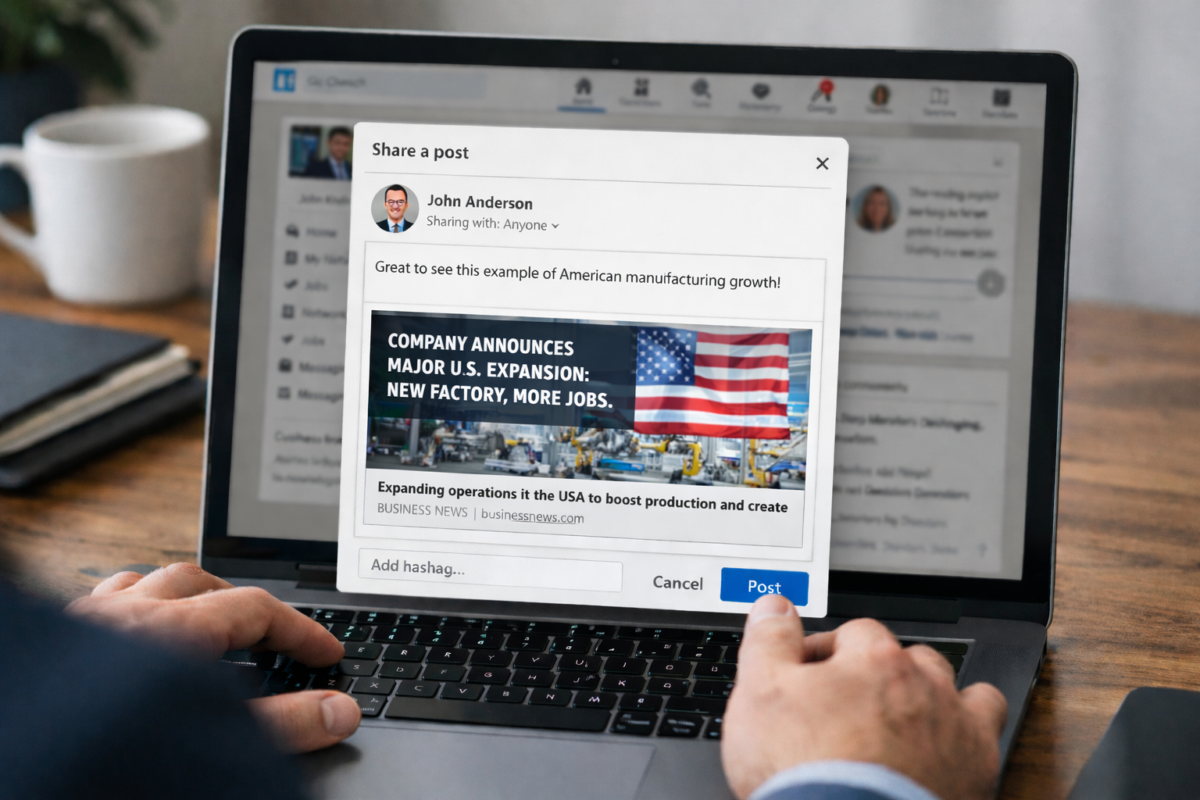
Social media amplification should extend well beyond a single post on the day an article appears. For B2B organizations, LinkedIn is by far the most important platform given its concentration of decision-makers and industry professionals.

The spokesperson who gave the interview should share the coverage and ideally add context on why the topic matters or what prompted the discussion. Amplification should not stop there. Employees, particularly those in leadership, sales, and subject-matter roles, can be encouraged to share the article with their own networks to extend reach organically.

In parallel, the company’s LinkedIn page should publish its own post written in a more institutional voice. That post can be reshared over time as the topic remains relevant or resurfaces in industry conversations. For especially strong or strategic coverage, selective paid promotion can further extend reach by placing credible third-party validation in front of clearly defined target audiences.

Extend the impact through newsletters

Email newsletters remain a powerful owned channel in B2B, particularly when audiences have opted in for insight rather than promotion. Earned media fits naturally into this environment.

Companies can include a short description of the article in their newsletter, either as native editorial content or as a link to the blog or newsroom post that references the coverage. Over time, consistently featuring earned media reinforces the perception that the organization’s perspectives are sought out by respected third parties.

Use earned media to support sales conversations

Beyond marketing channels, earned media can play a meaningful role in sales enablement. Links to relevant articles can be shared in one-to-one prospect emails, referenced in sales decks, or cited in RFP responses and procurement documentation.

In long B2B buying cycles, buyers often seek reassurance that a company is credible, established, and recognized beyond its own messaging. Earned media provides that validation at precisely the stage where trust and risk reduction matter most.

Use email signatures as quiet amplifiers

A subtle but effective tactic is to reference media coverage in email signatures. A single line such as “As featured in” followed by the publication name and a link to the article reinforces credibility in every external interaction.

Because email signatures appear in personal correspondence, this form of amplification feels understated rather than promotional. It works particularly well in sales, business development, and partnership contexts. Accuracy is essential. Companies should always link to the actual article and avoid language that could imply endorsement.

Reinforce credibility in branded search moments

Earned media also plays an important role when external audiences actively research a company. Prospective buyers rarely rely on a single source. Instead, they look for consistency between what a company says about itself and what independent third parties say about it.

By referencing media coverage on their own site and linking to original articles, companies strengthen branded search results without ceding narrative control. The goal is not for third-party articles to outrank owned pages, but for earned media to appear alongside them as independent validation when buyers are assessing credibility and reducing perceived risk.

Showcase media logos carefully and correctly

Many B2B websites include logos of media outlets in which the company has appeared. When done correctly, this can be a powerful trust signal. Tier-one and respected trade publications carry real brand equity, and prospective buyers notice.

Precision matters. Using phrasing such as “As featured in” is widely accepted and legally safe in the United States provided coverage is accurately represented and not overstated. Companies should avoid implying endorsement or partnership where none exists and remain selective in which logos they display.

Leverage print and broadcast within licensing rules

For organizations that rely heavily on in-person sales, conferences, or investor meetings, sharing media coverage in physical or audiovisual form can still be effective. A printed article or referenced broadcast segment can lend weight to conversations.

Legal considerations are critical. Reproducing print articles typically requires a license from the publisher. Without permission, companies are not allowed to copy or distribute articles, even if the coverage is about them.

The same principle applies to broadcast media. While it is acceptable to link to a television or radio segment on the outlet’s own platform, downloading an episode and hosting it on company-owned channels without permission is generally not allowed. Linking rather than hosting is the safest and most professional approach.

From moment to asset

When treated strategically, media coverage is not an endpoint but a starting point. Thoughtful amplification aimed at external audiences transforms earned media into a compounding asset that reinforces credibility across marketing, sales, and brand touchpoints long after the initial publication or airing.

For B2B companies operating in trust-driven, high-consideration markets, this shift in mindset can make the difference between fleeting attention and durable brand equity.

Categories
Media relations

How B2B Brands Should Organize Their Newsrooms in the Age of AI

B2B brands’ newsrooms should be treated as governed, easily discoverable, and AI-ready communications infrastructure that serves journalists with authoritative information while acting as the primary reference point for how both humans and AI agents understand the company.

For B2B brands, the corporate newsroom has long served as a practical interface between the organization and the media. At its best, it functions as a reliable hub where journalists can quickly find verified information, past announcements, and visual assets that support accurate reporting.

In the age of AI, and more specifically large language models, the role of the newsroom is expanding. It still needs to serve human journalists efficiently, but it must now also serve machine readers that increasingly influence how brands are discovered, summarized, and cited. This dual audience raises the bar for how newsrooms are structured, formatted, and governed.

Discoverability and naming matter

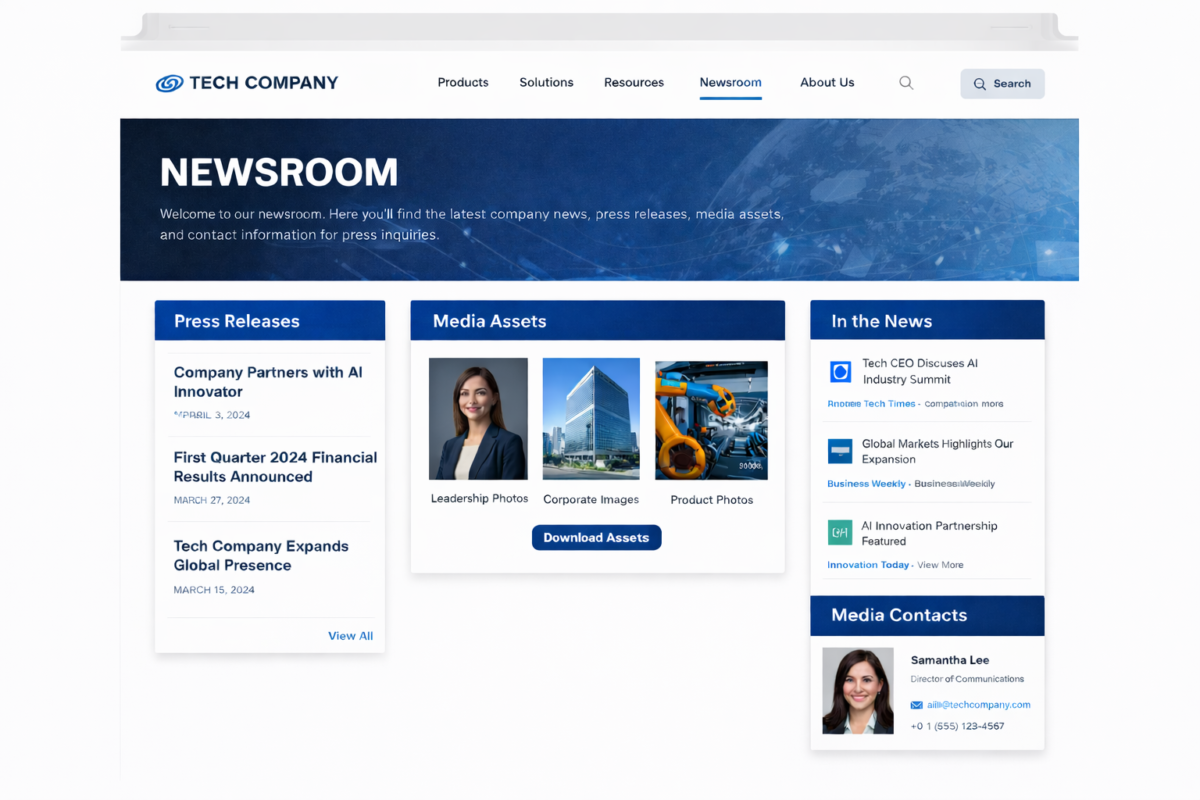
At a fundamental level, a B2B newsroom should be designed to remove friction for journalists. When reporters arrive at a newsroom, they are typically looking for authoritative background information on the company, a clear archive of past news, and usable visual assets.

This also means the newsroom must be easy to find. Best practice is to label it clearly as “Newsroom” or “Press” and make it accessible from the main navigation or footer of the corporate website. Some brands place newsroom content under labels such as “Knowledge Center” or “Resources.” While that may make sense internally, it creates unnecessary friction for journalists. If reporters have to guess where to look, many simply will not. A newsroom that is difficult to locate or ambiguously named undermines its own purpose, particularly in fast-moving news cycles where speed and clarity matter.

Governing key company information

One of the most important functions of a newsroom is providing verified, up-to-date key information about the company. For B2B brands, this may include metrics such as the number of customers, transactions processed, locations served, markets active in, or other scale indicators relevant to the industry.

What matters most here is governance. Decisions about which metrics are shared publicly should be made consciously at the management level and reflected consistently across the newsroom. The newsroom should follow those decisions, not drive them. For non-public companies in particular, publishing metrics is a strategic choice with implications for competitive positioning and future communications. Once approved, the newsroom becomes the single source of truth, reducing the risk of conflicting figures appearing across press releases, interviews, and third-party coverage. In an AI-mediated information environment, this consistency is increasingly important.

Presenting data for reuse

Professional presentation matters, but flexibility matters more. Current best practice is to make key data available both as branded visualizations and as raw, machine-readable data files, typically CSV.

Branded charts help contextualize information and are useful for trade media and digital outlets that welcome ready-to-use visuals. At the same time, many tier-one outlets prefer to apply their own visual style and will not use branded graphics. Providing raw data allows journalists to work directly from the source and build their own visuals quickly and accurately.

To be truly usable, raw data should be well documented. Column headers should be clear, units of measurement explicit, and dates formatted unambiguously, for example using ISO 8601. This ensures datasets can be ingested and interpreted correctly across tools, markets, and time zones, by both humans and machines.

Editorial-grade visual assets

Visual assets remain a core newsroom component, but standards are often misunderstood. Images in a newsroom should be editorial rather than commercial in nature.

This includes leadership headshots, images of headquarters or key locations, and images that show the product or service in delivery or operation. All imagery should be professionally produced and suitable for editorial use. Staged poses, exaggerated smiles, and people looking directly into the lens should be avoided. The objective is credibility and usability, not brand advertising.

Best practice is to make images available in multiple sizes and resolutions so journalists can download what best fits their needs. It is also important to communicate clearly how images should be credited.

Video and b-roll for newsrooms

For broadcast and digital video outlets, b-roll is often as important as still imagery. Effective newsroom b-roll consists of short, clean clips, typically five to ten seconds per shot, that can be embedded seamlessly into news content.

Footage should be unbranded, with no logos, lower thirds, or titles burned into the video. Any embedded branding complicates reuse and reduces the likelihood that footage will be selected. As with still images, b-roll should be easy to download, clearly described, and organized so editors can quickly identify what they need.

Structuring press releases for retrieval

Press releases remain a cornerstone of newsroom content, particularly for B2B brands that rely on formal announcements. Releases should be easy to consult and easy to sort.

At a minimum, they should be timestamped and presented in reverse chronological order. Tagging releases by topic allows journalists to quickly filter announcements without scrolling through years of content. A well-structured archive respects journalists’ time and increases the likelihood that past announcements are referenced accurately.

Media contacts and spokesperson clarity

A newsroom should also make it clear how journalists can engage with real people. At a minimum, this means listing a dedicated media contact with name, role, and direct contact details.

Where appropriate, it can also be helpful to indicate which executives or subject-matter experts speak on which topics, such as strategy, technology, regulation, or operations. Even limited clarity here reduces friction and accelerates the path from inquiry to interview, particularly when AI-driven research prompts rapid follow-up.

Boilerplates as living documents

Company boilerplates are often treated as static text, but they are among the most reused elements of a newsroom. A modern newsroom should maintain both short and long boilerplates, written in clear, factual language and updated as the company evolves.

Changes in positioning, scope, or market focus should be reflected deliberately and consistently. For large language models in particular, boilerplates frequently become the default definition of what a company does. Treating them as living documents ensures that both journalists and AI systems work from an accurate, current description.

Citation guidance for proprietary content

Some organizations go a step further and include explicit guidance on how proprietary material may be cited by the media. This is particularly relevant for companies that publish original research, benchmarks, forecasts, or other intellectual property that journalists frequently reference.

A clear example of this approach can be found in Forrester’s publicly available Media Citations Policy, which explains how Forrester research may be quoted, attributed, and reproduced by external media, and where prior approval is required. By setting expectations upfront, Forrester reduces misquotation, protects its intellectual property, and supports more accurate reporting. B2B brands that invest heavily in proprietary content may benefit from providing similar citation guidance within their newsroom.

Linking to earned media

A newsroom can also serve as a record of earned media coverage. Linking to past articles, interviews, or broadcast segments provides validation and context.

Coverage should be linked to rather than copied, unless content has been explicitly licensed. In some cases, a short summary can be helpful, but even a simple link is often sufficient. The objective is visibility and verification, not duplication.

Crisis readiness and dark pages

A newsroom should be designed not only for routine announcements, but also for moments of scrutiny. Increasingly, organizations prepare a dark page, a prebuilt page that can be activated quickly in a crisis or emerging issue.

A dark page typically includes a holding statement, space for verified updates, links to authoritative information, and clear media contact details. Embedding this capability within the newsroom allows organizations to respond quickly without improvising under pressure. In an AI-driven environment, this readiness also helps ensure that accurate, controlled information becomes the primary reference point for both journalists and machines.

Optimizing for LLMs

Finally, newsrooms must now be optimized not only for search engines but also for large language models. This requires clear structure, consistent headings, explicit labeling of data and dates, plain-language explanations of what the company does, machine-readable formats for data and text, and a deliberate effort to ensure the newsroom serves as the canonical source for company facts.

As LLMs increasingly shape discovery, summaries, and citations, the newsroom becomes more than a media tool. It becomes a strategic visibility asset.

A core communications infrastructure

For B2B brands, a well-organized newsroom is no longer optional. It is core communications infrastructure that supports accurate journalism, reinforces credibility, and increasingly informs AI-mediated understanding of the company.

Brands that treat their newsroom as a governed, living system rather than a static archive will be better positioned to control their narrative, support the media, and remain visible and credible in an environment where both humans and machines decide what gets attention.

Categories
Media relations

Webinar: Introduction to American tech media relations

On March 25th, Detavernier will host a webinar on American tech media relations with as a special guest Omar Gallaga (WSJ, CNN, Washington Post, NPR).

The webinar will focus on how European tech companies can be successful building their brands and activating demand through media relations on the American market. It is suited for entrepreneurs, marketing managers and PR managers. Topics that will be covered are:

  • The American tech media landscape
  • The American tech media relations toolbox
  • Crafting and pitching stories to American tech media
  • B2B thought leadership in American tech media
  • B2C product pr in American tech media
  • Media relations in times of COVID-19
  • Preparing and giving media interviews
  • Picking the PR tech stack
  • Sourcing consultancy services on the American market

SPECIAL GUEST Omar Gallaga (WSJ, CNN, NPR, Washington Post) will share his thoughts and experiences receiving media pitches on “the other side” and will be available to answer questions during a 15 min AMA session.

No public recording will be made available afterwards to anyone who has not registered.

To register, visit this page.