RACI helps PR teams avoid unforced errors by clearly defining who is responsible, accountable, consulted, and informed for each task, enabling faster execution and smoother collaboration.
Both B2B and B2C PR teams are under constant pressure to be effective and efficient. Resources are limited, deadlines are tight, and internal clients are demanding. Under those conditions, teams can ill afford unforced errors: time lost because responsibilities were unclear, approvals were missed, or key colleagues were left out of the loop.
These gaps show up in very practical ways. People fail to inform the right colleagues about the progress of an assignment. Team members do not realize that others are counting on them to complete a specific task. Work moves forward without an approval that should have been obtained. None of this reflects a lack of professionalism or intent. It reflects a lack of structural clarity around who does what.
What makes this particularly frustrating is that the solution is not new. The RACI model has its origins in management thinking from the 1950s, when organizations began formalizing responsibility structures to cope with growing scale and complexity. Decades later, that same logic remains highly relevant for modern PR teams juggling multiple stakeholders, channels, and fast-moving news cycles.
What Is RACI?
RACI is a framework for clarifying roles and responsibilities within a project or process. It assigns four possible roles to each task:
- Responsible
The person who does the work. - Accountable
The person who owns the outcome and has final decision-making authority. - Consulted
People whose input is required before the task is completed. - Informed
People who need to be kept up to date but are not directly involved in execution or decision-making.
For RACI to be effective, there needs to be agreement among the relevant internal stakeholders on how these roles are assigned. The value of RACI lies in shared understanding, not unilateral task allocation.
The strength of RACI lies in its clarity. For every task, it answers four essential questions: who does the work, who decides, who needs to be consulted, and who needs to be kept informed.
Why PR Teams Are Vulnerable Without RACI
PR work is inherently collaborative and cross-functional. A single deliverable such as a press release often involves PR, legal, marketing, executive leadership, and sometimes investor relations or HR. Without explicit role definition, assumptions fill the gaps.
This leads to predictable friction. Colleagues assume someone else is handling updates, approvals are delayed because ownership is unclear, and key stakeholders are consulted too late in the process. Executives may find themselves surprised by coverage they should have anticipated. In high-pressure environments, these issues compound quickly, consuming time and attention that could have been spent on execution.
RACI does not eliminate complexity, but it makes complexity manageable by replacing assumptions with clarity.
One Accountable and At Least One Responsible
A critical rule when applying RACI is that every task must have at least one person who is Responsible. If no one is clearly responsible for execution, the task will stall or fall between the cracks.
Each task should also have one Accountable person who owns the outcome and has final decision-making authority. When accountability is shared, it tends to be diluted.
In the day-to-day operations of a PR department, having one clearly designated Responsible owner per task is both advisable and feasible. PR work moves fast, dependencies are tight, and ambiguity around execution quickly translates into delays, rework, and missed deadlines. Clear responsibility keeps work moving and creates a natural point of coordination.
Consulted and Informed roles remain essential, but clarity around responsibility and accountability prevents confusion downstream.
A Practical Example: A B2B Technology Funding Announcement
Consider a B2B technology company preparing to announce a significant funding round. While this may appear to be a single PR moment, it consists of multiple interconnected tasks, among others:
- Drafting the press release
- Securing executive quotes
- Legal review and compliance checks
- Media list development
- Distribution of the press release
- Website update
- Follow-up with journalists
Using a RACI matrix before work begins allows the team to map responsibilities across these tasks clearly.
For example:
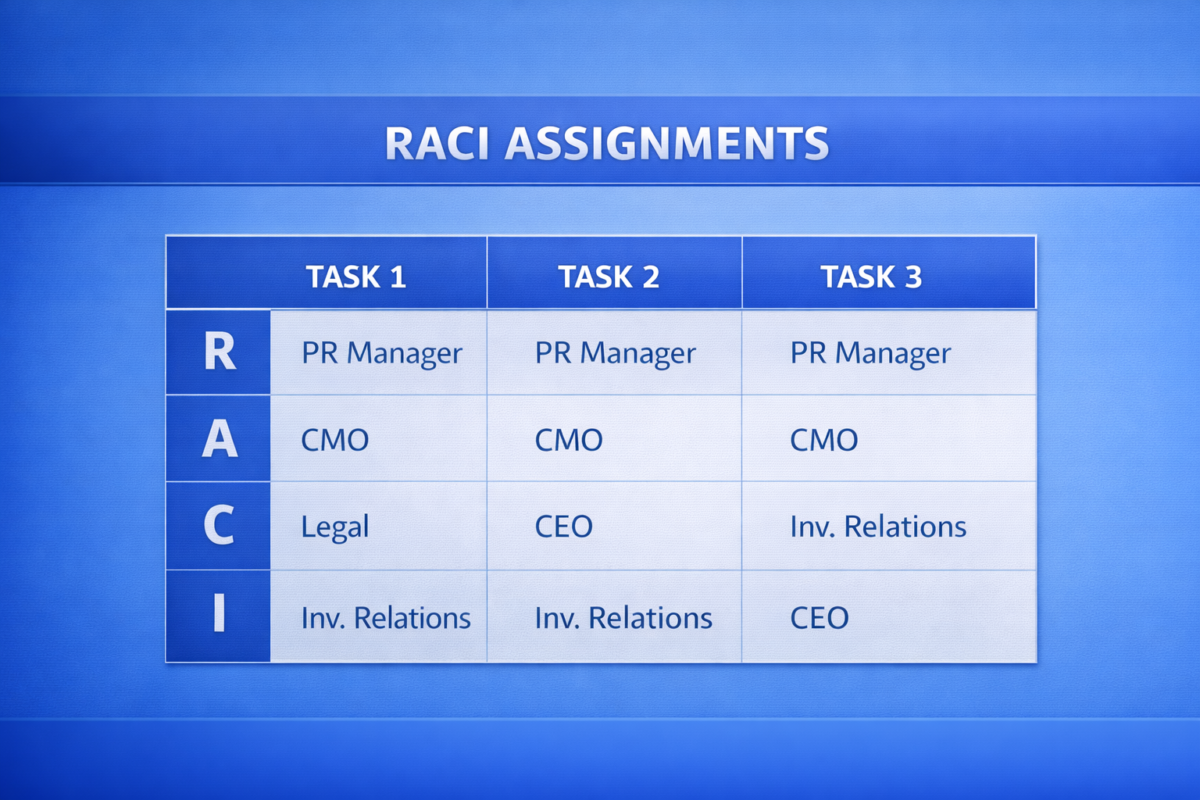
- Responsible (R)
The PR lead or PR manager executes the work. This includes drafting the press release, coordinating executive quotes, developing the media list, distributing the release, updating the website, and following up with journalists. - Accountable (A)
The CMO is accountable for the funding announcement as a whole and signs off on final messaging, timing, and execution. - Consulted (C)
Legal is consulted on disclosure language and compliance requirements.
The CEO is consulted on positioning and executive quotes. - Informed (I)
Investor Relations is informed ahead of distribution and follow-up to prepare for inbound questions from analysts and investors.
By documenting these roles upfront, the team removes ambiguity. Everyone knows who is doing the work, who owns the outcome, who needs to be consulted, and who needs to be kept informed.
RACI as a Planning Tool
RACI works best when it is used proactively during planning rather than after problems arise.
It also does not need to be bureaucratic. A simple table mapping tasks to roles is often sufficient. The goal is not documentation for its own sake, but shared understanding.
For PR leaders, RACI helps manage expectations with internal clients. When responsibilities are explicit, it becomes easier to explain timelines, approval steps, and dependencies.
A Small Investment With Outsized Returns
PR success depends not only on creativity and media savvy, but on execution discipline. Missed approvals, unclear ownership, and poor internal communication consume time and energy without adding value.
RACI helps PR teams avoid these unforced errors. By clarifying who does what, who decides, who advises, and who needs to be kept informed, teams can move faster, reduce friction, and focus on delivering results.
In an environment where resources are tight and expectations are high, that clarity is a competitive advantage.