
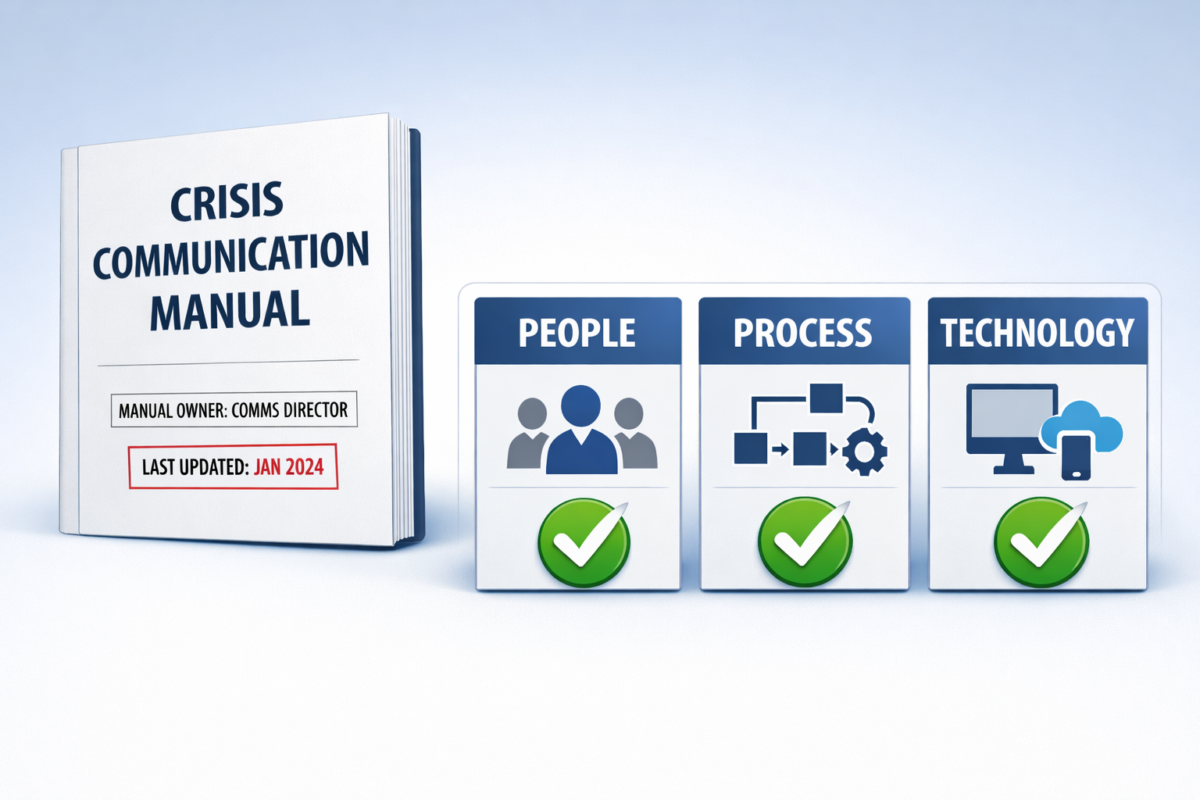
A crisis communication manual translates a company’s intent to communicate in a crisis into clearly defined people, processes, and tools that allow it to engage the media effectively when it matters most.
Crisis communication plans are often confused with disaster recovery plans or broader crisis management plans. While these plans are related, they serve different purposes. Disaster recovery and crisis management plans focus on restoring operations, managing the operational response to an incident, and ensuring business continuity. A crisis communication plan focuses exclusively on communication with the media.
This applies equally to B2B and B2C companies. Both have brand credibility, trust, and legitimacy at stake when something goes wrong. Silence or poorly structured media communication damages confidence regardless of whether the audience consists of consumers, investors, regulators, or business partners.
Many organizations remain underprepared. According to Capterra’s Crisis Communications Survey, only 49% of U.S. companies have a formal, documented crisis communication plan in place.
Organizations without a plan are forced to improvise when a crisis hits. Improvisation under time pressure and uncertainty leads to slow, inconsistent, or contradictory messaging, which compounds reputational damage rather than containing it.
A crisis communication plan is operationalized through a crisis communication manual. This is the document an organization relies on under pressure. The manual must have a clearly designated owner responsible for keeping it up to date and must clearly indicate the date of its most recent update.
Operational and non-operational crises
Crisis communication manuals must support both operational and non-operational crises.
An operational crisis involves a physical impact on people, assets, or the environment. Examples include industrial accidents, safety incidents, environmental releases, or infrastructure failures.
A non-operational crisis involves no physical or criminal harm but threatens the organization’s credibility, trust, or license to operate. A typical example is an allegation of misconduct that triggers media scrutiny while day-to-day operations continue.
The nature of the crisis may differ, but the media communication machinery required to manage it should not.
What effective crisis communication is meant to achieve
Crisis communication is often discussed in terms of tone, such as empathy or reassurance. Tone matters, but crisis communication priorities are sequential.
The first priority is safety. In operational crises, media communication may be required to provide safety-instructing information that explains what is happening and what actions people should take. When physical risk exists, this information must come before expressions of empathy or statements about control and must be coordinated with public authorities.
The second priority is explanation. Once immediate safety concerns are addressed—or immediately in non-operational crises—the organization must acknowledge the situation and explain what is known. Media outreach and newsroom updates should address what happened, where it occurred, who is involved, and what is being done to establish the facts. When this need is not met, speculation fills the gap.
Reputation management follows safety and explanation. Expressions of empathy and reassurances of control are most effective after substance has been provided. Credibility is preserved through consistent, accurate updates rather than premature claims of control.
A scenario-agnostic crisis communication manual
A crisis communication manual should be scenario agnostic.
It should not be written around specific incidents. The processes it defines, the task distribution within the crisis communication team, and the tools it provides must work across operational and non-operational crises alike.
The manual must be treated as a living document. Ownership and a visible update history prevent contact details, access credentials, and procedures from becoming obsolete.
The crisis communication manual: people, processes, and technology
A crisis communication plan becomes executable through a manual structured around people, processes, and technology.
People
The manual must define the crisis communication team, including responsibilities, decision authority, reporting lines, and backups. Typical roles include:
- crisis communication leader
- liaison with operational management teams
- media call taker
- copywriter
- distributor of statements and updates
- note-taker
- owner of the website newsroom CMS
- on-site spokesperson, where relevant
Not every organization needs a separate individual for each role, but every role must be covered. Spokesperson readiness should be addressed through regular media training and refreshers.
Process
The manual must define how crisis communication is executed under pressure, including:
- how the crisis communication team is activated
- who can declare a communications crisis
- escalation paths and approval workflows
- information flow from operational teams to media messaging
- validation of updates as facts evolve
- media monitoring and assessment
- identification and correction of misinformation
- criteria for declaring the crisis “off” from a media relations perspective
- review and update cycles for the manual itself
Clear processes reduce friction when time and clarity are most constrained.
Technology
The technology pillar covers the tools and resources required to operate effectively under pressure:
- a single media inquiry intake and routing mechanism
- a pre-approved holding statement repository
- templates, message maps, and factsheets
- a media distribution system, including wire services
- press briefing infrastructure with backup options
- a pre-curated media asset library linked to the newsroom CMS
- a knowledge map identifying internal subject-matter owners
- version control for all approved materials
- archiving and audit trails for media-facing content
- login credentials and access instructions for all systems used
The manual must also define technology substitutes and fallback options. Systems can fail during a crisis. If a media CRM or distribution platform is unavailable, the manual should specify which alternative system can be used, such as a monitored corporate media inbox.
An important end note: preparation requires practice
Crisis communication manuals are necessary but insufficient. They do not prepare an organization on their own.
Preparation requires regular desktop exercises and drills that train people to execute the roles, processes, and tools defined in the manual. Without practice, even a well-designed crisis communication plan remains theoretical.