
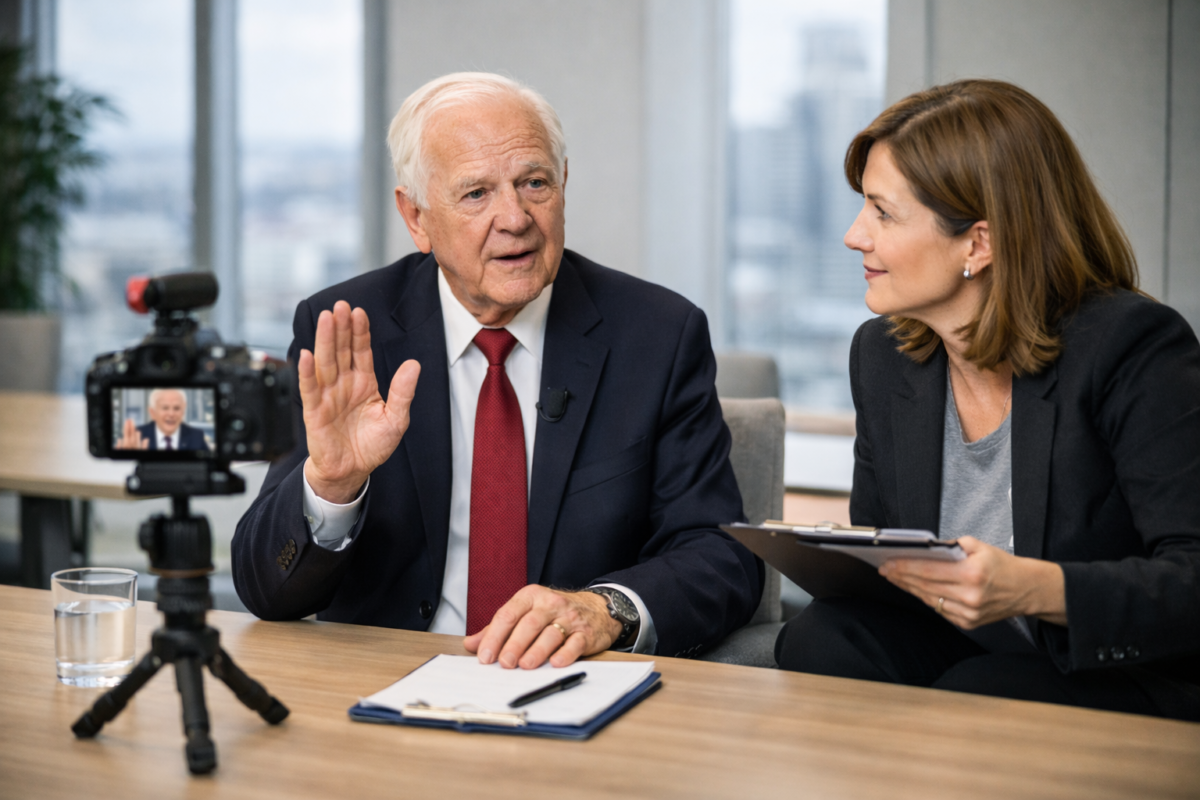
Media training for the CEO is a structured, realistic process that aligns message discipline, delivery skills, and thought leadership persona to ensure the CEO communicates with authority and strategic intent when it matters most.
The CEO is the spearhead of a company’s strategic communication. When it matters most, it is the CEO who speaks. Not frequently, but deliberately. Major announcements, defining moments, crises, and long-term positioning all require the authority, credibility, and visibility that only the CEO can provide. This makes every media interaction involving the CEO consequential and places a high bar on preparation.
Media training for a CEO is relevant at any stage of experience. It can support a newly appointed leader who is still finding their footing with the media, as well as a seasoned CEO who has given countless interviews. Depending on the experience of the CEO, some of the elements described below will receive more or less emphasis. In all cases, the objective is not to teach someone how to talk, but to sharpen performance, reinforce consistency, and ensure that media appearances actively support the company’s strategic objectives.
Two inputs are essential to effective CEO media training: an assessment of past performance and an assessment of the CEO’s thought leadership persona.
Assessing Past Performance
Past media appearances provide a concrete and objective starting point. They reveal strengths to build on and weaknesses that need attention, both in delivery and, where visible, in message design.
On the verbal level, common issues include difficulty handling negative questions, losing structure when interrupted, over-answering, or drifting away from key messages under pressure. Some CEOs become defensive when challenged. Others struggle to close answers decisively or to regain control once a journalist reframes the discussion.
Non-verbal performance is equally important. Pacing may be rushed or overly measured. Eye contact may be inconsistent. Posture and composure can unintentionally signal uncertainty or defensiveness. Even in print or online interviews, vocal delivery, rhythm, and emphasis influence how messages are perceived. Reviewing past performance allows these elements to be identified and addressed in a targeted way.
Defining the Thought Leadership Persona
Beyond technique, a CEO’s media presence is shaped by how they are perceived as a thought leader. Thought leadership comes in many forms, and it is useful to acknowledge this explicitly at CEO level. This persona does not emerge arbitrarily, but reflects a communication style the CEO has consciously or implicitly chosen because it feels authentic and comfortable.
A CEO who communicates primarily as an evangelist will typically emphasize conviction, momentum, and belief, while a CEO who leans more toward a visionary posture may place greater weight on long-term direction and strategic intent. These are only two possible examples of thought leadership style.
The thought leadership persona does not replace or override the company’s message architecture. Primary messages, supporting messages, proof points, and factual guardrails remain constant. It does however influence which proof points are foregrounded, how examples are framed, how much emphasis is placed on ambition versus execution, and the tone in which messages are delivered.
If the thought leadership persona of the CEO has never been communicated to them in explicit terms, the trainer will follow the persona that comes closest to the CEO’s implicit communication style, as observed in past media appearances and early interactions during the training.
Making Media Training Realistic
Media training is only effective if it feels real. This requires simulated interviews that mirror actual media interactions and are grounded in real business developments.
Executives are rarely interviewed without context. Journalists typically approach them with a topic, an angle, or a reason for the conversation. Training should reflect that reality. Ahead of the session, the CEO should receive two interview requests for as many simulated interviews. These requests are handled by the trainer or a co-trainer acting as journalists. They outline the topic and indicate some of the questions that may be asked, but not all of them.
Ideally, these interviews relate to a specific announcement that is being prepared. This increases realism and engagement and encourages the CEO to invest effort in the exercise. It also allows the CEO to work from a draft press release or an existing message map, mirroring real-world preparation.
Interview requests are typically shared three to four working days before the training session.
Structure of the Training Session
A CEO media training usually lasts between ninety minutes and two hours. Theory and practice are interwoven. The CEO speaks, learns, applies, and speaks again.
From a practical perspective, CEOs are best trained individually. Media training is demanding, and few executives benefit from making mistakes in front of the CEO. If budget constraints require a group setting, participants should be at a comparable seniority level.
The session often begins with a concise overview of how the media operate, what journalists look for, and how interviews fit into the broader media ecosystem. This establishes context without overwhelming the trainee.
A first simulated interview follows quickly. Trainers should design this interview in a way that allows the CEO to make mistakes. Learning is most effective when it emerges from experience rather than instruction.
The Hot Debrief
Immediately after the first interview, a hot debrief takes place. The CEO is asked to reflect on their own performance before receiving external feedback. This approach increases ownership of the learning process and improves receptiveness to coaching.
At this stage, the trainer also assesses how the CEO prepared for the interview. If the CEO did not work from clearly defined key messages and proof points, this moment is used to introduce the message map as a preparation tool. The trainer explains how key messages are structured, how proof points support them, and how this framework helps maintain control during interviews. When the CEO is asked to develop a message map, it goes without saying that they are invited to do so with the support of the Director of PR or another senior communications leader, if such a person is available (see also later).
The trainer then adds observations, explanations, and targeted guidance, supported by video playback of specific moments. Recording the interview allows for precise feedback and avoids reliance on memory alone, particularly when a single trainer conducts both the interview and the evaluation.
Teaching Core Media Techniques
Even in the first interview, trainers typically introduce foundational techniques.
Bridging teaches the CEO how to transition from a question to key messages, regardless of whether the question is positive, neutral, or negative. Headlining focuses on leading with the core message before supporting it with proof points. Flagging emphasizes the use of explicit signals to indicate what matters most.
These techniques are reinforced through repeated application rather than abstract explanation.
Increasing Complexity
The second simulated interview is usually more demanding than the first. Trainers introduce interruptions, loaded questions, and false dilemmas that force unacceptable alternatives. Performance again drives learning. Effective techniques are acknowledged and reinforced. Weaknesses are addressed with clear, actionable guidance.
If the CEO did not arrive with prepared key messages for subsequent interviews, additional preparation time is built in. Typically, an extra five minutes are given before the second and third interviews for the CEO to prepare using the message map introduced during the hot debrief. This preparation can again be done with the support of the Director of PR or another senior internal communications leader, if available.
Ideally, a third simulated interview follows. It is not more complex than the second, but it allows the CEO to apply what has been learned and to finish with a markedly stronger performance than at the start. Media interviewing is a skill, not a talent, and visible improvement reinforces confidence and motivation.
Understanding Different Media Formats
Simulating interviews across different formats helps the CEO understand the varying demands of different media. Print and online interviews place greater emphasis on clarity, structure, and quotability, while on-camera interviews add layers of non-verbal communication, composure, and presence.
Experiencing both formats during training allows the CEO to appreciate how answers must be adapted without compromising message integrity. The trainer actively guides the CEO through these differences and helps them navigate the expectations of each medium.
Multi-Channel Learning and Multimedia Reinforcement
From a learning perspective, the training deliberately follows a multi-channel approach. Learning is more effective when information is processed through different cognitive channels rather than through words alone. Live interaction, spoken feedback, and video recordings activate complementary forms of processing.
Recording the CEO’s own performance already engages multiple channels by combining verbal content with visual and non-verbal cues. Adding short video clips of other CEOs demonstrating effective and ineffective techniques provides additional content for visual processing. These clips create reference points that support comparison and pattern recognition, helping the trainee internalize best practices more quickly.
This multi-channel exposure strengthens retention and transfer. The CEO does not only hear what works or review their own performance, but also observes how similar techniques are executed by others, which accelerates assimilation and sharpens judgment.
Written and Unwritten Rules of Media Interviews
An effective CEO media training also covers the written and unwritten rules that govern media interviews.
This includes a clear explanation of what it means to speak on the record, off the record, and on background, and how these distinctions are applied in practice. CEOs need to understand that these terms are not interchangeable and that assumptions about confidentiality can lead to misunderstandings if not explicitly agreed upon.
The trainer also explains how media embargoes work, including why journalists use them, how they are honored, and what risks arise when embargoes are misunderstood or broken. This knowledge helps the CEO navigate complex media situations with confidence and protects the organization from unintended disclosure.
Institutional Alignment and Follow-Up
While it is generally not advisable to train multiple people during the interviews themselves, it is valuable to involve a senior communications leader such as a Director of PR or another internal communications leader in the session. This person can support feedback on messages and proof points and ensure alignment with existing communication policies and frameworks.
If such a representative cannot be present, the trainer must be briefed in advance on existing messaging frameworks, from message maps to message catalogues. These frameworks act as guardrails against which the CEO is trained.
An effective CEO media training combines realistic simulation, structured feedback, escalating challenge, and institutional alignment into a single, coherent learning experience.
An effective follow-up includes a personalized one-page debrief summarizing strengths, improvement areas, and practical guidance for future interviews. Learning is further enhanced by incorporating multimedia examples, such as short clips of other CEOs demonstrating effective and ineffective use of the techniques covered.
Media training at CEO level is not about scripting or performance for its own sake. It is about ensuring that when the CEO speaks, selectively and with intent, their presence advances the company’s strategy, credibility, and long-term positioning.