
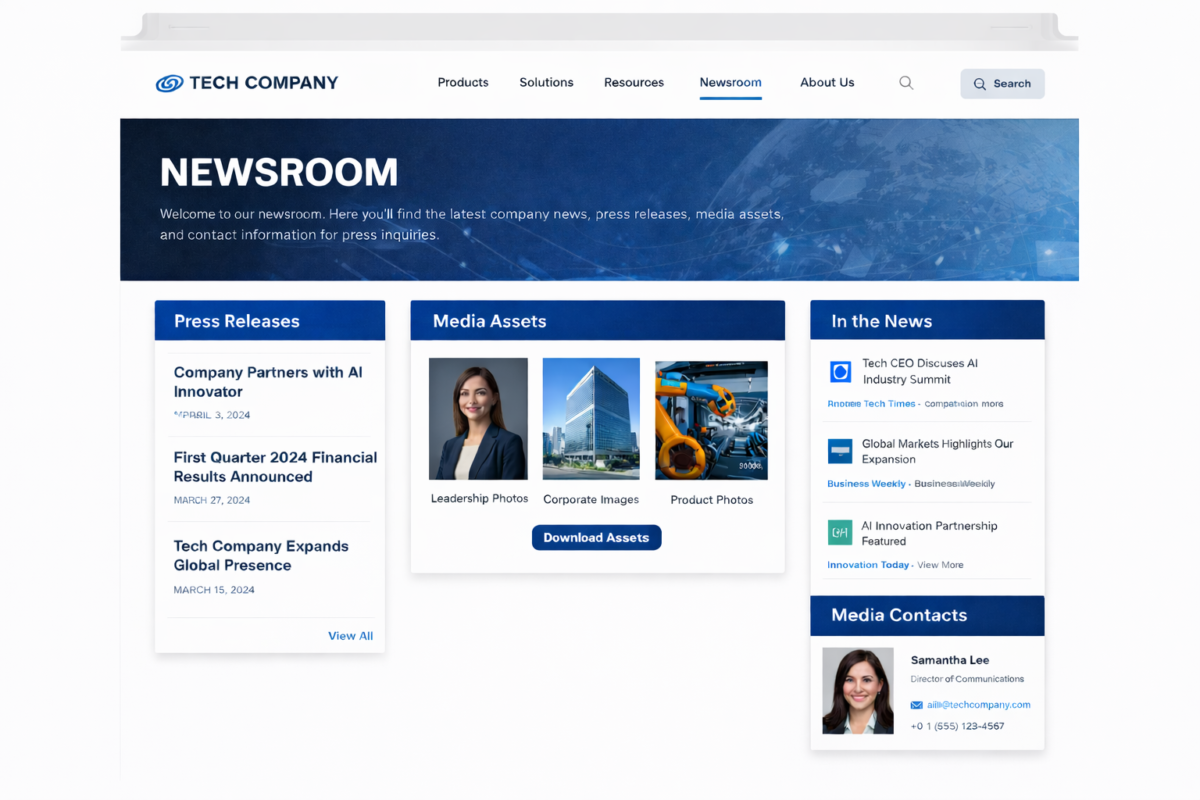
B2B brands’ newsrooms should be treated as governed, easily discoverable, and AI-ready communications infrastructure that serves journalists with authoritative information while acting as the primary reference point for how both humans and AI agents understand the company.
For B2B brands, the corporate newsroom has long served as a practical interface between the organization and the media. At its best, it functions as a reliable hub where journalists can quickly find verified information, past announcements, and visual assets that support accurate reporting.
In the age of AI, and more specifically large language models, the role of the newsroom is expanding. It still needs to serve human journalists efficiently, but it must now also serve machine readers that increasingly influence how brands are discovered, summarized, and cited. This dual audience raises the bar for how newsrooms are structured, formatted, and governed.
Discoverability and naming matter
At a fundamental level, a B2B newsroom should be designed to remove friction for journalists. When reporters arrive at a newsroom, they are typically looking for authoritative background information on the company, a clear archive of past news, and usable visual assets.
This also means the newsroom must be easy to find. Best practice is to label it clearly as “Newsroom” or “Press” and make it accessible from the main navigation or footer of the corporate website. Some brands place newsroom content under labels such as “Knowledge Center” or “Resources.” While that may make sense internally, it creates unnecessary friction for journalists. If reporters have to guess where to look, many simply will not. A newsroom that is difficult to locate or ambiguously named undermines its own purpose, particularly in fast-moving news cycles where speed and clarity matter.
Governing key company information
One of the most important functions of a newsroom is providing verified, up-to-date key information about the company. For B2B brands, this may include metrics such as the number of customers, transactions processed, locations served, markets active in, or other scale indicators relevant to the industry.
What matters most here is governance. Decisions about which metrics are shared publicly should be made consciously at the management level and reflected consistently across the newsroom. The newsroom should follow those decisions, not drive them. For non-public companies in particular, publishing metrics is a strategic choice with implications for competitive positioning and future communications. Once approved, the newsroom becomes the single source of truth, reducing the risk of conflicting figures appearing across press releases, interviews, and third-party coverage. In an AI-mediated information environment, this consistency is increasingly important.
Presenting data for reuse
Professional presentation matters, but flexibility matters more. Current best practice is to make key data available both as branded visualizations and as raw, machine-readable data files, typically CSV.
Branded charts help contextualize information and are useful for trade media and digital outlets that welcome ready-to-use visuals. At the same time, many tier-one outlets prefer to apply their own visual style and will not use branded graphics. Providing raw data allows journalists to work directly from the source and build their own visuals quickly and accurately.
To be truly usable, raw data should be well documented. Column headers should be clear, units of measurement explicit, and dates formatted unambiguously, for example using ISO 8601. This ensures datasets can be ingested and interpreted correctly across tools, markets, and time zones, by both humans and machines.
Editorial-grade visual assets
Visual assets remain a core newsroom component, but standards are often misunderstood. Images in a newsroom should be editorial rather than commercial in nature.
This includes leadership headshots, images of headquarters or key locations, and images that show the product or service in delivery or operation. All imagery should be professionally produced and suitable for editorial use. Staged poses, exaggerated smiles, and people looking directly into the lens should be avoided. The objective is credibility and usability, not brand advertising.
Best practice is to make images available in multiple sizes and resolutions so journalists can download what best fits their needs. It is also important to communicate clearly how images should be credited.
Video and b-roll for newsrooms
For broadcast and digital video outlets, b-roll is often as important as still imagery. Effective newsroom b-roll consists of short, clean clips, typically five to ten seconds per shot, that can be embedded seamlessly into news content.
Footage should be unbranded, with no logos, lower thirds, or titles burned into the video. Any embedded branding complicates reuse and reduces the likelihood that footage will be selected. As with still images, b-roll should be easy to download, clearly described, and organized so editors can quickly identify what they need.
Structuring press releases for retrieval
Press releases remain a cornerstone of newsroom content, particularly for B2B brands that rely on formal announcements. Releases should be easy to consult and easy to sort.
At a minimum, they should be timestamped and presented in reverse chronological order. Tagging releases by topic allows journalists to quickly filter announcements without scrolling through years of content. A well-structured archive respects journalists’ time and increases the likelihood that past announcements are referenced accurately.
Media contacts and spokesperson clarity
A newsroom should also make it clear how journalists can engage with real people. At a minimum, this means listing a dedicated media contact with name, role, and direct contact details.
Where appropriate, it can also be helpful to indicate which executives or subject-matter experts speak on which topics, such as strategy, technology, regulation, or operations. Even limited clarity here reduces friction and accelerates the path from inquiry to interview, particularly when AI-driven research prompts rapid follow-up.
Boilerplates as living documents
Company boilerplates are often treated as static text, but they are among the most reused elements of a newsroom. A modern newsroom should maintain both short and long boilerplates, written in clear, factual language and updated as the company evolves.
Changes in positioning, scope, or market focus should be reflected deliberately and consistently. For large language models in particular, boilerplates frequently become the default definition of what a company does. Treating them as living documents ensures that both journalists and AI systems work from an accurate, current description.
Citation guidance for proprietary content
Some organizations go a step further and include explicit guidance on how proprietary material may be cited by the media. This is particularly relevant for companies that publish original research, benchmarks, forecasts, or other intellectual property that journalists frequently reference.
A clear example of this approach can be found in Forrester’s publicly available Media Citations Policy, which explains how Forrester research may be quoted, attributed, and reproduced by external media, and where prior approval is required. By setting expectations upfront, Forrester reduces misquotation, protects its intellectual property, and supports more accurate reporting. B2B brands that invest heavily in proprietary content may benefit from providing similar citation guidance within their newsroom.
Linking to earned media
A newsroom can also serve as a record of earned media coverage. Linking to past articles, interviews, or broadcast segments provides validation and context.
Coverage should be linked to rather than copied, unless content has been explicitly licensed. In some cases, a short summary can be helpful, but even a simple link is often sufficient. The objective is visibility and verification, not duplication.
Crisis readiness and dark pages
A newsroom should be designed not only for routine announcements, but also for moments of scrutiny. Increasingly, organizations prepare a dark page, a prebuilt page that can be activated quickly in a crisis or emerging issue.
A dark page typically includes a holding statement, space for verified updates, links to authoritative information, and clear media contact details. Embedding this capability within the newsroom allows organizations to respond quickly without improvising under pressure. In an AI-driven environment, this readiness also helps ensure that accurate, controlled information becomes the primary reference point for both journalists and machines.
Optimizing for LLMs
Finally, newsrooms must now be optimized not only for search engines but also for large language models. This requires clear structure, consistent headings, explicit labeling of data and dates, plain-language explanations of what the company does, machine-readable formats for data and text, and a deliberate effort to ensure the newsroom serves as the canonical source for company facts.
As LLMs increasingly shape discovery, summaries, and citations, the newsroom becomes more than a media tool. It becomes a strategic visibility asset.
A core communications infrastructure
For B2B brands, a well-organized newsroom is no longer optional. It is core communications infrastructure that supports accurate journalism, reinforces credibility, and increasingly informs AI-mediated understanding of the company.
Brands that treat their newsroom as a governed, living system rather than a static archive will be better positioned to control their narrative, support the media, and remain visible and credible in an environment where both humans and machines decide what gets attention.