

Headlining is a media interview technique that helps spokespeople lead with their most important message so it is heard, remembered, and preserved through journalistic filtering and editing.
Media interviews can be demanding, especially for less experienced spokespeople. They require focus, clarity, and the ability to think on your feet, often under time pressure and with limited room for error. But even very experienced spokespeople can struggle to consistently get their message across to the audience they actually want to reach.
Knowing and applying delivery techniques puts a floor under performance. It does not guarantee a perfect interview, but it reduces the risk of a poor one. Delivery techniques help spokespeople stay oriented, communicate more efficiently, and protect their core messages from being diluted, misunderstood, or lost altogether.
Headlining is one such delivery technique. Like repetition, flagging, and bridging, it is designed to ensure that key messages actually reach the audience. Headlining means that a spokesperson leads with the core message first and then elaborates on that message with proof points. When there is more than one key message, those messages are grouped and followed by proof points that support one or several of them.
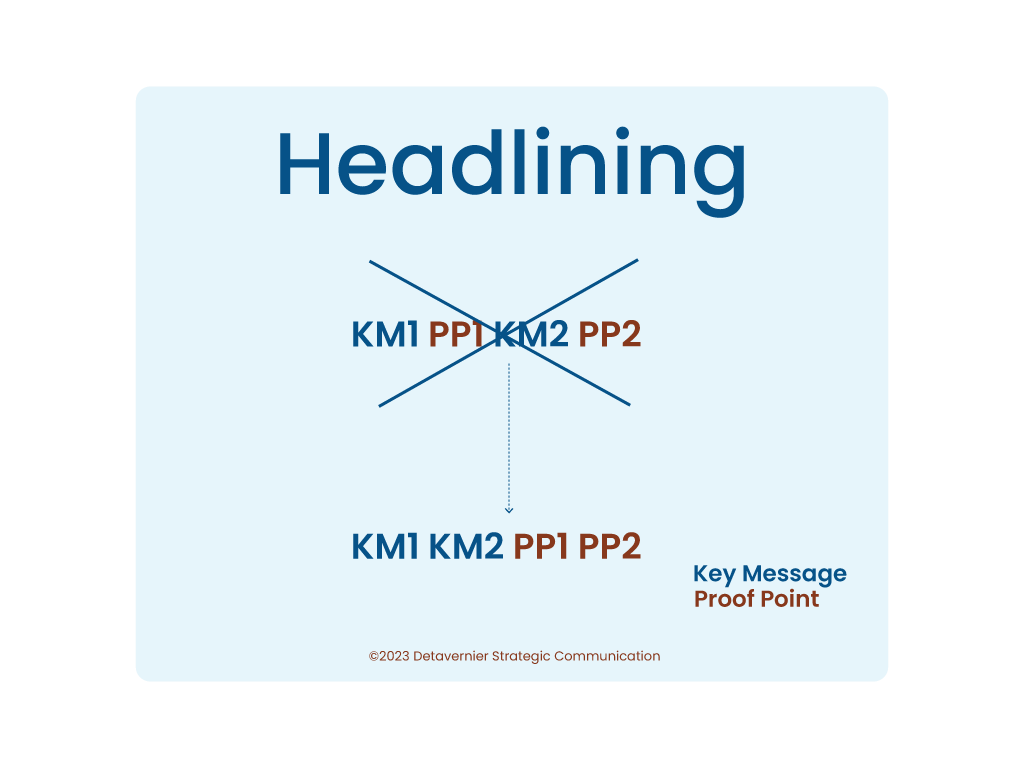
The technique is simple, but its impact is significant. By stating the most important idea upfront, spokespeople increase the likelihood that their message is understood, remembered, and retained as the interview unfolds.
Journalist attention and the filtering effect
One reason headlining works so well is that journalists operate under severe attention constraints. During interviews, they are most likely to register what is said at the beginning and what is said toward the end. Anything that falls in between competes for attention with follow-up questions, time pressure, and the journalist’s need to shape a story.
If a spokesperson does not lead with the key message, there is a real risk that the most important point never passes through the journalist’s filter at all. Audiences will never receive a message that the journalist does not pick up. Headlining acknowledges this reality and adapts to it, rather than assuming that every explanation will be heard in full.
Editing risk in recorded interviews
Headlining also matters because many interviews are recorded and edited. Background explanations, nuance, and examples are often the first elements to be cut when time or space is limited. When a spokesperson builds toward a key message instead of leading with it, that message may disappear entirely in the edit.
By contrast, when the key message is stated clearly and early, it is far more likely to survive. Even if an answer is shortened, the essential point remains intact. Headlining therefore protects messages not just in the moment of the interview, but in what audiences ultimately see, hear, or read.
How people remember information
Headlining also aligns with how people process and remember information. Audiences tend to recall what they hear first and what they hear last. Attention naturally fluctuates, especially in longer interviews or technical discussions.
Leading with the most important message increases the chance that it is remembered, even if attention drops later or if only a short quote or clip is ultimately used. In this sense, headlining serves both the journalist’s workflow and the audience’s cognitive limitations.
Staying focused as a spokesperson
There is also a benefit for the spokesperson. Interviews can easily drift as follow-up questions, anecdotes, or examples pull the conversation in different directions. Without a clear internal structure, spokespeople may over-elaborate or lose sight of what they intended to say.
By stating the headline message upfront, spokespeople give themselves an anchor. It becomes easier to recognize when an answer is drifting and to return to what matters most.
An example of headlining in practice: proptech
Consider a proptech CEO asked:
“Why are real estate firms investing so heavily in data and software right now?”
A non-headlined answer might sound like this:
“There has been a lot of change in the market, and companies are trying to respond to tenant expectations. Technology has evolved quickly, and there are new tools available that weren’t there before. At the same time, margins are under pressure, and firms are looking for efficiencies across operations, leasing, and asset management.”
The answer may be accurate, but the key message is diffuse. A journalist could easily edit this down to a generic statement about “market change” or “new tools,” losing the strategic rationale altogether.
A headlined answer starts differently:
“Real estate firms are investing in proptech to make better decisions faster in a more volatile market. Data and software allow owners to price assets more accurately, manage energy use more efficiently, and respond more quickly to tenant needs. In an environment where margins matter, better information has become a competitive advantage.”
The difference is not substance, but sequence. The key message is clear from the first sentence, and the proof points explain why it matters. Even if the answer is shortened in editing, the strategic point survives.
Why headlining improves outcomes
Used consistently, headlining allows spokespeople to communicate with greater clarity, protects key messages from being lost in editing, and increases the odds that both journalists and audiences take away what matters most. It is a simple technique, but one that reflects a realistic understanding of how media interviews actually work.