
Categories
Uncategorized

Digital Trust Signals for B2B Thought Leaders

Digital trust signals are the publicly visible cues that help journalists verify the credibility of B2B thought leaders by assessing their profiles, content, past coverage, and the professionalism of the companies they represent.

Once a company has defined its thought leadership program and decided which topics to prioritize and which experts will speak to them, the real work begins. At that point, the program moves from planning to execution. Having insightful things to say, even when those insights are backed up with solid data, is rarely enough to break through the noise.

This is especially true for B2B thought leaders who are not yet on journalists’ speed dial. When a journalist receives a pitch for an interview or a contributed article, one of the first questions they ask themselves is simple: Who is this? A PR professional, whether in-house or agency-side, will have provided background information, role, and relevance in the pitch itself. Journalists nevertheless conduct their own credibility check before deciding whether to proceed.

That is where digital trust signals come in. Digital trust signals are the easily discoverable and externally visible indicators that help journalists, editors, and producers assess whether a thought leader is credible, consistent, and worth their time. Below are some of the most important ones and how to get them right.

LinkedIn: the primary credibility checkpoint

Journalists often check social media as part of their reporting process. In the Muck Rack State of Journalism Report (2021), 86 percent of journalists indicated that when reporting on a company, they consult the company’s social media sometimes, usually, or always.

For B2B thought leaders, the most prominent of those channels is LinkedIn. LinkedIn functions as a public résumé, positioning statement, and credibility filter at the same time. It is also one of the easiest places for journalists to verify whether an expert’s claims align with what they can independently observe.

Thought leaders should ensure that the About section of their LinkedIn profile clearly reflects how they are positioned and signals the domains in which they claim authority. If an expert is presented as a leader in a given field, that positioning should be unmistakable in the About section.

Beyond the About section, public elements such as Interests, including followed companies, groups, and newsletters, contribute to the overall impression. While not every element is always visible to non-connections, journalists often see enough to form a view. These visible signals should reinforce, not contradict, the expert narrative being presented.

Posting behavior also matters. Journalists do not expect daily updates, but they do expect thematic consistency. Content should broadly reinforce the professional positioning. Content that is inflammatory, confusingly off-brand, or unrelated to the expert’s domain can raise questions.

Other social media platforms: coherence over activity

On platforms such as X, content does not need to be business-focused. Personal interests and cultural commentary are acceptable, provided they do not conflict with the professional brand being presented.

An expert who shares content that undermines credibility introduces doubt, even when that content is unrelated to the pitch topic. Journalists may not articulate this explicitly, but it influences decision-making.

Dormant or abandoned accounts deserve attention. Accounts that have not been updated for years signal neglect and can be more damaging than having no account at all. If a platform is no longer used, it is often better to deactivate the account than to leave it unattended.

Previous interviews: social proof still matters

The most reliable way to secure an interview is to have been interviewed before. This is difficult when launching a new thought leader, but any credible prior exposure helps. Interviews with trade publications, podcasts, or regional outlets function as social proof. Mentioning these selectively in a pitch reassures journalists that others have already vetted the expert.

For recorded interviews, producers assess not only subject-matter expertise but also clarity, composure, and performance on audio or video. For that reason, pitches should include links to previous recorded interviews whenever possible, especially early in a thought leader’s trajectory.

Owned thought leadership content: expertise you can verify

Owned thought leadership content is one of the strongest and most underused digital trust signals. Blog posts are particularly effective.

When a pitch advances a specific point of view and the expert has already articulated that perspective in a well-reasoned blog post, that piece should be shared with journalists. It allows them to evaluate the quality of thinking and clarity of expression without committing to an interview first.

Blog posts do not need to be long or academic. What matters is that they express a clear point of view, engage with real-world developments, and avoid promotional language. Over time, even a modest body of well-written articles creates an intellectual footprint that journalists can quickly assess and trust.

Company assets: supporting the expert’s credibility

Journalists rarely evaluate experts in isolation. The organization behind the spokesperson forms part of the credibility assessment, particularly when the company itself is relatively unknown.

Start-ups, scale-ups, and smaller mid-market companies should therefore ensure their basic assets are in order. This starts with a professional website and an easily accessible newsroom where journalists can confirm that the company is real, active, and evolving.

That newsroom should also contain aforementioned expert coverage, including interviews, articles, podcasts, or video appearances that have already been acquired. Centralizing this material reinforces legitimacy and shows that others have already engaged with the company and its experts.

Company social media presence matters as well, especially the LinkedIn company page. It should appear current and intentional, with regular updates reflecting business developments and insights. While follower counts are not decisive, reaching a baseline audience of around 500 followers helps signal that the company has a real footprint.

Digital trust is cumulative

None of these trust signals work in isolation. Journalists look for consistency across everything they see.

For B2B thought leadership in particular, credibility is not assumed. It is verified. In an environment where journalists are inundated with pitches, digital trust signals help distinguish between experts who merely claim authority and those who demonstrably earn it.

For PR professionals, B2B thought leaders, and growing companies alike, investing in these signals is foundational rather than cosmetic.


Categories
Uncategorized

Detavernier Strategic Communication Supports Beckers Group U.S. Crisis Readiness

Detavernier Strategic Communication has been retained to support the U.S. division of Beckers Group within the context of its broader crisis communication readiness efforts.

For the German company, a crisis management framework was first developed centrally and is now gradually being implemented across 16 countries on five continents.

About Beckers Group

Beckers Group is a privately owned, global coatings company that develops high-quality, environmentally compatible paint systems. The company’s expertise is built on a history of more than 150 years.

Today, approximately 1,800 employees work across 23 production sites in 17 countries, providing products and custom-made solutions to customers in close to 60 countries around the world. Beckers Group serves industrial customers globally and is known for its long-term focus on sustainability, innovation, and close collaboration with its partners.

Part of a Broader European–U.S. Collaboration

This engagement takes place within the context of Detavernier Strategic Communication’s participation in a German-led network of boutique agencies, designed to enable structured cross-border collaboration for international clients.

Through this network, the firm supports globally operating organizations on communication challenges that require coordinated execution across countries, regions, and markets.

Image disclaimer: The stock image used in this article is for illustrative purposes only and does not depict Beckers Group offices, facilities, or employees.

Categories
Uncategorized

How B2B Brands Can Newsjack Effectively

Newsjacking is one of the most effective ways for B2B brands to insert themselves into an active news cycle when it is done with discipline, speed, and genuine expertise.

At its core, newsjacking means contributing insight to breaking or fast-developing news stories that journalists are already covering. These developments can relate to economic shifts, regulatory decisions, corporate bankruptcies, technological breakthroughs, court rulings, or geopolitical events. When a brand can credibly add context, analysis, or foresight, it earns a legitimate place in the coverage.

What Newsjacking Looks Like in Practice

Consider a marketing firm that specializes in retail. A major retail chain files for bankruptcy. Within hours of the news breaking, the firm reaches out to relevant business and trade media to offer analysis. The pitch focuses on what the retailer did well and poorly from a marketing perspective, how consumer behavior shifted, and what other retailers can learn from the failure.

Because the firm contributes insight rather than promotion, journalists may include its perspective in their reporting. The result is increased visibility, credibility, and association with a timely and relevant news event. This outcome, however, rarely happens by chance. Effective newsjacking requires a deliberate process.

Defining the Topics You Can Credibly Own

Newsjacking starts well before any news breaks. Brands must first define the topics they are qualified to speak about, a task that typically belongs within a broader thought-leadership plan.

The topics selected should align with ongoing public conversations while also reflecting areas where the brand has genuine experience. Trending issues alone are not enough. Credibility matters, and journalists can quickly distinguish between informed analysis and opportunistic commentary. The strongest newsjacks come from brands that have helped clients navigate similar situations or have deep operational knowledge of the subject matter.

Turning Topics Into Followable News Targets

Knowing what topics to speak to is necessary, but it is not sufficient. Those topics must be operationalized by identifying concrete news developments that are likely to unfold in the future.

In the retail bankruptcy example, warning signs often appear well before the final filing. Declining earnings, store closures, layoffs, or analyst downgrades usually receive media attention first. These signals allow a brand to identify a specific company or situation to monitor closely. By selecting followable targets, brands move from abstract expertise to practical readiness.

Mapping Trigger Events in Advance

Following a target alone does not guarantee success. Brands also need to anticipate when the topic is likely to return to the news agenda.

This requires identifying trigger events that journalists are likely to cover. An economist seeking to comment on inflation, for instance, may focus on Federal Reserve interest-rate policy. In that case, scheduled FOMC meetings and rate announcements become predictable moments when media demand for expert analysis spikes.

Other trigger events include earnings calls, court decisions, regulatory deadlines, government votes, policy announcements, industry conferences, and data releases. Mapping these moments allows PR teams to prepare in advance rather than reacting after the story has already peaked.

Preparing Points of View and Quotes Ahead of Time

One of the most overlooked aspects of newsjacking is preparation. Experts should not wait until the news breaks to determine what they think.

A technology executive anticipating a government decision on AI policy, for example, should use the lead-up period to define a clear and defensible point of view. This preparation typically results in a concise explanation of what the development means, accompanied by one or more quotable statements. In many cases, it is prudent to prepare alternative versions that reflect different possible outcomes.

When the news finally breaks, the heavy lifting has already been done. A brief check-in with the expert may still be appropriate to ensure relevance, but the response can be immediate.

Packaging the Newsjack for Media Use

The format of a newsjacking pitch is intentionally simple. It usually consists of a short paragraph that outlines the expert’s perspective, followed by a clear, well-crafted quote. The pitch also invites journalists to follow up for an interview or an exclusive quote if they want to go deeper.

Clarity and speed are essential. Journalists covering breaking news do not have time for lengthy explanations or promotional language. The value must be immediately apparent.

Monitoring, Activating, and Distributing at the Right Moment

Execution is the final step in the process and rests largely with the PR team. This involves closely monitoring the news for the trigger event, alerting the expert that outreach is about to begin, confirming availability when interviews are likely, and distributing the pitch quickly and selectively to relevant media.

Timing plays a decisive role. Responding early, without speculating, significantly increases the likelihood that the insight will be included in coverage.

Knowing When Not to Newsjack

Not every news development presents a good opportunity for commentary. Discretion is essential.

There are situations where speaking publicly may be unwise or counterproductive, such as during sensitive lobbying efforts, regulatory negotiations, or legal proceedings. In other cases, adverse events affecting an entire industry may be better handled quietly, as additional commentary could amplify negative attention rather than contain it.

When Newsjacking Gets Confused With Ambulance Chasing

Newsjacking is most often confused with ambulance chasing when it takes place in the wake of adverse or negative events. That confusion is not inherent to the practice itself but to how it is executed.

Commenting on bankruptcies, court rulings, economic downturns, or other unfavorable developments is not inappropriate in itself. These events often have broad implications, and journalists actively seek expert analysis to help their audiences understand what happened, why it matters, and what it means for others.

The line is crossed only when commentary becomes self-serving, speculative, or designed to exploit misfortune rather than explain it. When analysis is factual, measured, and clearly aimed at adding context or insight, it is regarded as legitimate expert contribution rather than opportunistic pitching.

For B2B brands, the standard should be the same regardless of whether the news is positive or negative. If the contribution helps journalists do their job better and provides value to their audience, it is newsjacking done right.

Categories
Uncategorized

The core components of a crisis communication plan for companies

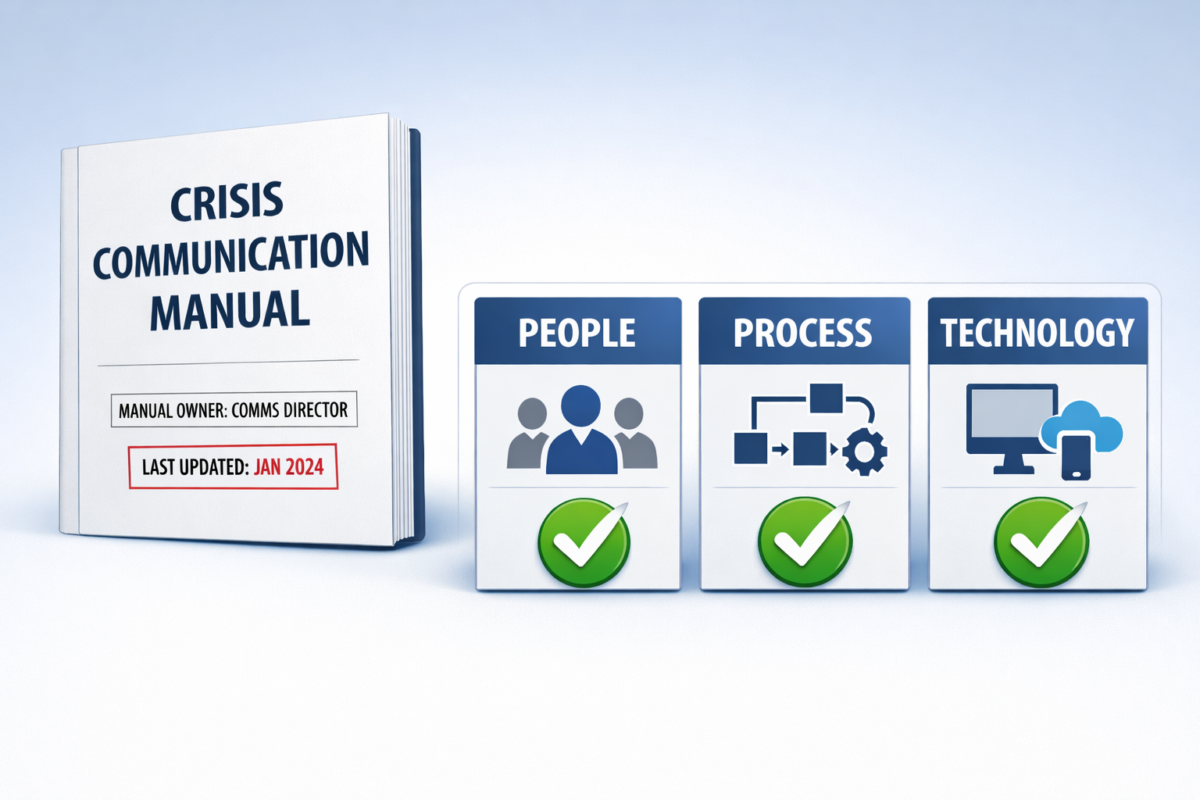
A crisis communication manual translates a company’s intent to communicate in a crisis into clearly defined people, processes, and tools that allow it to engage the media effectively when it matters most.

Crisis communication plans are often confused with disaster recovery plans or broader crisis management plans. While these plans are related, they serve different purposes. Disaster recovery and crisis management plans focus on restoring operations, managing the operational response to an incident, and ensuring business continuity. A crisis communication plan focuses exclusively on communication with the media.

This applies equally to B2B and B2C companies. Both have brand credibility, trust, and legitimacy at stake when something goes wrong. Silence or poorly structured media communication damages confidence regardless of whether the audience consists of consumers, investors, regulators, or business partners.

Many organizations remain underprepared. According to Capterra’s Crisis Communications Survey, only 49% of U.S. companies have a formal, documented crisis communication plan in place.

Organizations without a plan are forced to improvise when a crisis hits. Improvisation under time pressure and uncertainty leads to slow, inconsistent, or contradictory messaging, which compounds reputational damage rather than containing it.

A crisis communication plan is operationalized through a crisis communication manual. This is the document an organization relies on under pressure. The manual must have a clearly designated owner responsible for keeping it up to date and must clearly indicate the date of its most recent update.

Operational and non-operational crises

Crisis communication manuals must support both operational and non-operational crises.

An operational crisis involves a physical impact on people, assets, or the environment. Examples include industrial accidents, safety incidents, environmental releases, or infrastructure failures.

A non-operational crisis involves no physical or criminal harm but threatens the organization’s credibility, trust, or license to operate. A typical example is an allegation of misconduct that triggers media scrutiny while day-to-day operations continue.

The nature of the crisis may differ, but the media communication machinery required to manage it should not.

What effective crisis communication is meant to achieve

Crisis communication is often discussed in terms of tone, such as empathy or reassurance. Tone matters, but crisis communication priorities are sequential.

The first priority is safety. In operational crises, media communication may be required to provide safety-instructing information that explains what is happening and what actions people should take. When physical risk exists, this information must come before expressions of empathy or statements about control and must be coordinated with public authorities.

The second priority is explanation. Once immediate safety concerns are addressed—or immediately in non-operational crises—the organization must acknowledge the situation and explain what is known. Media outreach and newsroom updates should address what happened, where it occurred, who is involved, and what is being done to establish the facts. When this need is not met, speculation fills the gap.

Reputation management follows safety and explanation. Expressions of empathy and reassurances of control are most effective after substance has been provided. Credibility is preserved through consistent, accurate updates rather than premature claims of control.

A scenario-agnostic crisis communication manual

A crisis communication manual should be scenario agnostic.

It should not be written around specific incidents. The processes it defines, the task distribution within the crisis communication team, and the tools it provides must work across operational and non-operational crises alike.

The manual must be treated as a living document. Ownership and a visible update history prevent contact details, access credentials, and procedures from becoming obsolete.

The crisis communication manual: people, processes, and technology

A crisis communication plan becomes executable through a manual structured around people, processes, and technology.

People

The manual must define the crisis communication team, including responsibilities, decision authority, reporting lines, and backups. Typical roles include:

  • crisis communication leader
  • liaison with operational management teams
  • media call taker
  • copywriter
  • distributor of statements and updates
  • note-taker
  • owner of the website newsroom CMS
  • on-site spokesperson, where relevant

Not every organization needs a separate individual for each role, but every role must be covered. Spokesperson readiness should be addressed through regular media training and refreshers.

Process

The manual must define how crisis communication is executed under pressure, including:

  • how the crisis communication team is activated
  • who can declare a communications crisis
  • escalation paths and approval workflows
  • information flow from operational teams to media messaging
  • validation of updates as facts evolve
  • media monitoring and assessment
  • identification and correction of misinformation
  • criteria for declaring the crisis “off” from a media relations perspective
  • review and update cycles for the manual itself

Clear processes reduce friction when time and clarity are most constrained.

Technology

The technology pillar covers the tools and resources required to operate effectively under pressure:

  • a single media inquiry intake and routing mechanism
  • a pre-approved holding statement repository
  • templates, message maps, and factsheets
  • a media distribution system, including wire services
  • press briefing infrastructure with backup options
  • a pre-curated media asset library linked to the newsroom CMS
  • a knowledge map identifying internal subject-matter owners
  • version control for all approved materials
  • archiving and audit trails for media-facing content
  • login credentials and access instructions for all systems used

The manual must also define technology substitutes and fallback options. Systems can fail during a crisis. If a media CRM or distribution platform is unavailable, the manual should specify which alternative system can be used, such as a monitored corporate media inbox.

An important end note: preparation requires practice

Crisis communication manuals are necessary but insufficient. They do not prepare an organization on their own.

Preparation requires regular desktop exercises and drills that train people to execute the roles, processes, and tools defined in the manual. Without practice, even a well-designed crisis communication plan remains theoretical.

Categories
Uncategorized

What Crisis Communicators Need to Know About Sorry Laws

Sorry laws define the legal boundary that allows crisis communicators to express empathy after an incident without turning empathic statements into admissions of liability, making legal awareness essential to effective crisis messaging.

When a crisis hits, communicators will naturally want to acknowledge what happened and show empathy toward those affected. From a legal standpoint, however, statements that come close to—or are perceived as—apologizing can carry risk, as they may later be scrutinized as potential admissions of fault. This tension between humane communication and legal exposure is exactly where sorry laws come into play and why crisis communicators need to understand them.

Sorry laws, also known as apology laws, shape what organizations can safely say after an incident. They do not eliminate legal risk, nor do they replace legal counsel. They do, however, define the legal boundaries within which crisis communicators operate when crafting early responses that acknowledge harm and express concern.

Why crisis communicators need to understand the law

Crisis communication does not take place in a vacuum. In any material incident—whether an industrial accident, a product failure, a data breach, or an environmental spill—public statements will be reviewed through a legal lens. Legal counsel will assess language for admissions, exposure, and downstream litigation risk before senior leadership speaks publicly.

Communicators who understand the legal context are better positioned to act as strategic advisors rather than tactical editors. Knowing how sorry laws work allows communicators to level with legal counsel and understand the constraints under which counsel will advise leadership. It also explains why certain formulations are likely to be approved while others are likely to be struck.

Communicators who anticipate this review can design messages that stay within legal boundaries and explicitly signal this when submitting a first draft. This moves the communicator upstream in the decision-making process and strengthens their role as a credible advisor rather than a last-minute reviewer.

What sorry laws are and what they are not

At their core, sorry laws exist to allow individuals and organizations to communicate empathy after an incident—literally, to say “sorry”—without that expression being used against them in court proceedings to establish liability.

Most sorry laws protect expressions of sympathy or benevolence, such as statements conveying compassion, regret, or concern for those affected. In many jurisdictions, such expressions are inadmissible as evidence when offered to prove fault.

At the same time, sorry laws are neither uniform nor unlimited. Not all states have them. Many statutes protect sympathy but not admissions of fault. Some laws apply broadly, while others were drafted with specific contexts in mind. Statements that move beyond empathy and address negligence, causation, or responsibility may still be admissible. This distinction is central for crisis communicators, because saying “we are sorry this happened” is legally very different from saying “we are sorry we caused this.”

How widespread are sorry laws?

According to the National Conference of State Legislatures, thirty-nine U.S. states, the District of Columbia, and Guam have laws that protect expressions of sympathy, condolences, or apologies by medical professionals from being admitted as evidence against them in civil court. While these statutes are often discussed in a medical context, several jurisdictions extend similar protections more broadly, including to accident situations.

For crisis communicators, this provides an important baseline. Apology protections are relatively common, but their scope, wording, and applicability vary significantly by jurisdiction. Knowing that a law exists is not enough. Understanding how it is written is what matters.

Texas as a concrete example

Texas provides a clear illustration of how sorry laws work in practice.

Section 18.061 of the Texas Civil Practice and Remedies Code states:

“A court in a civil action may not admit a communication that expresses sympathy or a general sense of benevolence relating to the pain, suffering, or death of an individual involved in an accident if the communication is offered to prove liability of the communicator.”

The statute defines “communication” broadly, explaining that it includes “a statement, a writing, or a gesture that conveys a sense of compassion or commiseration emanating from humane impulses.”

At the same time, Texas law draws a clear boundary. Communications that include statements of negligence or culpable conduct are not protected and may still be admissible in court.

For crisis communicators, the takeaway is straightforward. In Texas, there is legal room to express empathy early and publicly, provided that messaging remains focused on compassion and avoids language that implies fault or causation.

California’s approach

California’s approach is similar in structure, though articulated differently.

Under California Evidence Code § 1160:

“The portion of statements, writings, or benevolent gestures expressing sympathy or a general sense of benevolence relating to the pain, suffering, or death of a person involved in an accident and made to that person or the family of that person shall be inadmissible as evidence of an admission of liability in a civil action.”

The statute then adds an important limitation:

“A statement of fault, however, which is part of, or in addition to, any of the above shall not be inadmissible pursuant to this section.”

In practical terms, California law protects only the empathetic portion of a communication. Any accompanying admission of fault remains admissible. For crisis communicators, this reinforces the same operational principle seen in Texas: empathy is protected; fault is not.

One of the most effective ways crisis communicators can add value is by anticipating legal review rather than reacting to it.

Communicators who understand sorry laws can design initial statements that clearly separate expressions of sympathy from any discussion of cause or responsibility. They can also proactively explain how the language aligns with applicable statutes when submitting drafts for review.

Explicitly signaling this awareness reduces friction with legal counsel and reinforces the communicator’s credibility as a risk-aware advisor rather than a tone-focused advocate.

The strategic value of empathy

Beyond legal considerations, empathy has strategic value. Silence following an incident often fuels speculation, anger, and reputational damage. Stakeholders such as employees, customers, local communities, and regulators expect acknowledgment and concern.

Sorry laws exist in part because lawmakers recognized that discouraging basic expressions of humanity can exacerbate conflict rather than reduce it. From a crisis management perspective, carefully worded expressions of concern can demonstrate leadership presence, reduce escalation, and buy time for investigation and response without prematurely committing the organization to legal positions it may later regret.

What sorry laws do not replace

Sorry laws do not eliminate legal risk, nor do they replace the role of legal counsel. They do not authorize communicators to make admissions or override legal advice. Instead, they define the space in which communicators and lawyers can collaborate more effectively.

The goal is not to practice law, but to communicate with legal literacy.

Conclusion

Crisis communication is as much about judgment as it is about words. Understanding sorry laws equips communicators with the context they need to exercise that judgment responsibly.

By knowing whether apology protections exist in their jurisdiction, how those protections are formulated, and where their limits lie, crisis communicators can draft safer initial statements, anticipate legal review, advise leadership with confidence, and preserve empathy without escalating legal exposure.

In high-stakes situations, that combination of human sensitivity and legal awareness is what distinguishes credible crisis advisors from well-intentioned but risky communicators.